
Expert content

Unlocking the Power of Grain Cleaners: Insights, Innovations, and Industry Updates
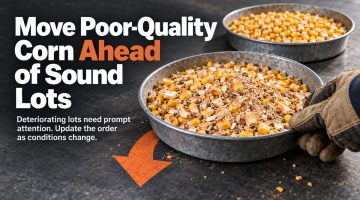
Illustration of a corn shipment board prioritizing deteriorating lots, then stable poor-quality lots, with sound, dry, cool lots reserved for later movement.
Move Poor-Quality Corn Ahead of Sound Lots
Conceptual illustration of frost obstructing a grain-bin vent screen, with a headline about pressure relief during cold-weather aeration.
Check Bin Vents Before Running Aeration Fans Near Freezing
Editorial illustration of hands reviewing a building sketch on a workbench. An orange pencil circles the space between a plain gray equipment footprint and a wall, emphasizing room for operation and service.
Leave Room to Work Around Your Grain Cleaner
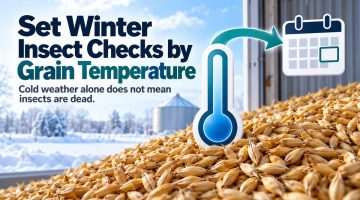
Conceptual illustration of a thermometer symbol rising from stored barley and connecting by a curved arrow to a calendar, emphasizing grain-temperature-based winter insect checks.
Use Grain Temperature to Schedule Winter Insect Checks
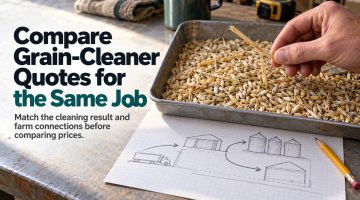
Editorial illustration of two grain-cleaner quote sheets beside one farm handling sketch, with oats on the worktable and the headline “Two Quotes. One Cleaning Job.”
Compare Grain-Cleaner Quotes for the Same Job and Farm Setup
Conceptual illustration of two bulk corn lots labeled suspect corn and sound grain, kept apart by a solid divider at receiving.
Keep Mold-Affected Corn Separate and Test Before Choosing Its Destination
Editorial illustration of a farmer in a baseball cap placing a sealed bag of yellow corn on an indoor bench. The farmer's hand and arm are visibly connected to the body. Large text advises warming a questionable cold-grain sample before deciding to dry again.
Check a Cold-Grain Moisture Reading Before Drying Again
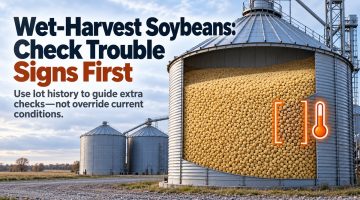
Editorial illustration of a soybean-bin cutaway with an amber thermometer symbol marking one location for closer attention, while other bins recede behind it. The headline advises checking current trouble signs first.
Which Soybean Lots Need Closer Attention After a Wet Harvest?
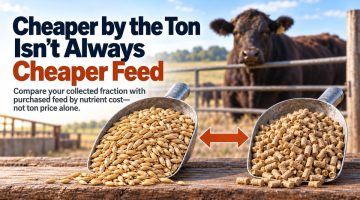
Editorial illustration of a barley sample, calculator and conceptual feed-analysis comparison sheet under the headline “Value the Nutrients, Not Just the Ton.”
Compare a Collected Grain Fraction With the Cattle Feed It Could Replace
Editorial illustration of a cupped hand examining whole green field peas above a sack of pea screenings mixed with dry pod fragments, stems and fine debris. The headline asks whether another cleaning pass is worthwhile.
When Recleaning Screenings Can Retain Useful Grain
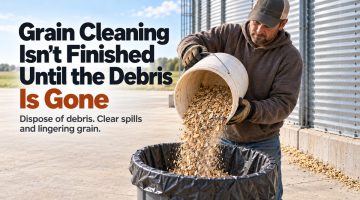
Illustration of a broom gathering spilled oats, broken grain and settled dust into a dustpan near a storage threshold, with the headline “Grain Cleaned? Clear the Leftovers.”
Finish Grain Cleaning by Clearing Debris and Spills
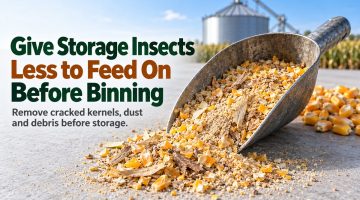
Conceptual cover illustration of a tipped metal scoop containing cracked corn, settled grain dust and husk fragments, with whole corn kernels behind it and a softly blurred grain bin in the distance. The headline reads, “Give Storage Insects Less to Feed On Before Binning.”
Give Storage Insects Less to Feed On Before Binning Grain
Conceptual illustration of an oat stream with dust, chaff and straw directed aside before color selection. Pale and darker oats remain together in the continuing stream.
Before Color Sorting: Remove Dust and Debris From Incoming Grain
Conceptual illustration of barley mixed with dust and chaff, highlighting useful grain and unwanted material beneath the headline “Feed Grain: Remove Trash, Keep Useful Grain.”
Cleaning Feed Grain. Remove Dust and Chaff, Keep Useful Grain
Conceptual illustration comparing a fuller corn kernel with a hollowed kernel. Simple interior fill and open space represent retained and missing material, not measured cleaning results. Headline: “Insect-Damaged Corn: Recover the Useful Fraction.”
Insect-Damaged Corn and How Cleaning Can Recover Useful Grain
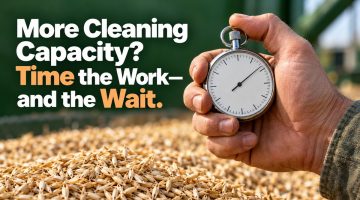
Editorial illustration of a working hand holding a stopwatch above softly focused oats, with the headline “More Cleaning Capacity? Time the Work—and the Wait.”
Would More Grain Cleaning Capacity Keep Harvest Moving?
Conceptual illustration of a grain route from a storage bin through a labeled cleaning step to a truck, with a separate branch for removed material.
Where to Install a Grain Cleaner Before Truck Loading
Conceptual illustration comparing barley kernels with larger and similarly sized stones, under the headline “Stones in Grain? Start With Size.”
Stones in Harvested Grain. What Determines the Cleaning Approach?
Conceptual illustration of size screening corn from a bin core, with larger yellow kernels above a screen and smaller corn particles below.
Corn From the Bin Core: When Screening Helps Keep Useful Grain
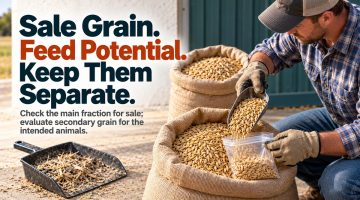
Conceptual illustration of two separate pans of oats labeled “Sale review” and “Feed evaluation,” under the headline “One Grain Lot, Two Possible Uses.”
One Grain Lot, Two Uses. When Cleaning Can Support Sale and Feed
Conceptual illustration of shelled corn along a receiving-to-drying-to-storage route, with open-circle markers highlighting possible screening points during existing transfers.
Wet Corn: Where to Fit Cleaning Between Receiving, Drying and Storage
Conceptual illustration of sunflower seeds beside branching airflow graphics, with labels showing the goal of keeping fully filled seeds and separating empty and poorly filled seeds.
Empty Sunflower Seeds: Can Airflow Cleaning Separate Them?
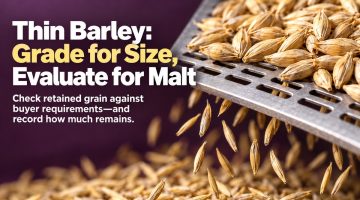
Conceptual illustration of thin barley kernels set apart from a fuller barley grouping, with the headline “Thin Barley: Grade for Size, Check for Malt.” The groups illustrate size selection, not measured cleaning results.
Thin Barley: What Size Grading Can Do for a Malt Candidate
Soybeans beside a settlement sheet separating payable bushels from price per bushel, showing the two places a foreign-material deduction can affect payment.
Soybean Foreign-Material Deductions: Less Weight, Lower Price - or Both?
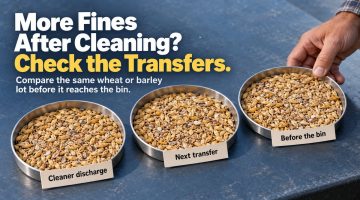
Conceptual editorial illustration of three labeled barley inspection dishes on a blue workbench. A hand brings the before-bin sample beside samples from cleaner discharge and the next transfer for comparison.
More Fines After Cleaning? Follow Wheat and Barley to the Bin
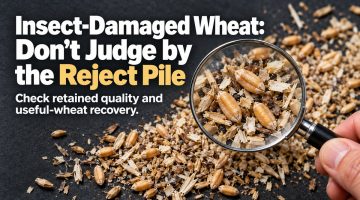
Conceptual illustration of wheat in an inspection tray beside a larger container on a scale, pairing retained quality with the amount of useful wheat recovered.
Insect-Damaged Wheat: When Separation Is Worth Trying
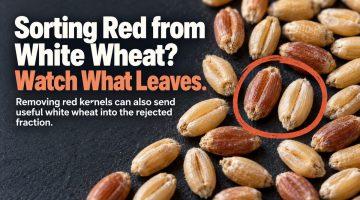
Editorial illustration of pale tan and reddish-brown wheat kernels mixed together, with the headline “Red Wheat in White Wheat?” and the labels “Color contrast” and “Wheat class.”
Red Wheat in White Wheat: Can Color Sorting Help?
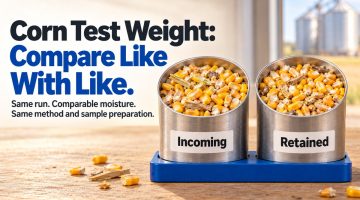
Editorial illustration of incoming and retained corn sample bags paired for comparison, with a separate delivery document showing the two purposes of corn test-weight readings.
Corn Test Weight Before and After Cleaning: Compare Like With Like
Conceptual illustration of falling barley kernels and similarly sized dry plant fragments, with a blue airflow arrow suggesting lighter fragments drifting sideways. The headline reads, “Screened Grain Still Has Light Material? Airflow May Help.”
Light Material Left After Screening? When Airflow Helps
Editorial illustration of a hand comparing a dry plant fragment with wheat in a sample tray, beside the terms dockage and foreign material.
Wheat Dockage or Foreign Material? What the Report Means for Cleaning
Editorial illustration of yellow corn on a conceptual screening surface. Small chips pass through openings while whole kernels and a larger broken piece remain above. The headline connects screening with what buyers count.
Broken Corn: What Screening Removes—and What the Buyer Counts
Conceptual illustration of soybeans, dry pods and straw beside a route showing coarse debris diverted before drying, with the headline “Soybean Pods and Trash: Screen Before the Heat?”
Pods and Trash in Soybeans: When to Screen Before Drying
Conceptual illustration of a laptop showing hands presenting a corn sample, with corn beside the screen and the headline “See Your Grain in a Sample Test.”
Not Sure Your Grain Will Separate? Start With a Sample Test
Metra ADS aerodynamic grain cleaners help farmers clean and calibrate soybean seed by separating it into fractions
Soybeans for 2027 Planting: What Cleaning and Seed Tests Can Tell You
Editorial macro illustration comparing whole soybeans, a large split and much smaller fragments on a slate-gray surface, emphasizing the size differences that determine whether screening can help.
Split Soybeans Before Storage: When Screening Helps
Editorial illustration of hands examining a soybean sample in a shallow tray, with the headline “Damaged Soybeans: What Can Cleaning Keep?” No cleaning result is depicted.
Shriveled Soybeans: When Cleaning Can Help Keep Useful Beans
A farmer beside an open bag of oats, steadying a body-wide agricultural cleaning screen that rests on the floor and reaches approximately waist height.
Weed Seeds in Grain: When to Try Screens or Airflow
Conceptual illustration of barley samples labeled incoming, retained and removed fractions, showing why kernels in rejects must be judged alongside the whole cleaning run.
Good Grain in the Rejects? Compare the Whole Cleaning Run
Conceptual illustration of a corn bin cutaway showing small debris concentrated beneath the filling point, with reminders to dry promptly, screen out debris and cool with aeration.
Corn Sprouted on the Ear? What to Do Before Storage
For oilseed headed to a press, clean before storage when the lot contains substantial weed seeds, pods or chaff.
Oilseed for Pressing. Clean Before Storage or Before the Press?
In the VDSC+ADS combination, VDSC first screens out larger and smaller impurities.
Debris Remains After ADS Cleaning: When Screening First Helps
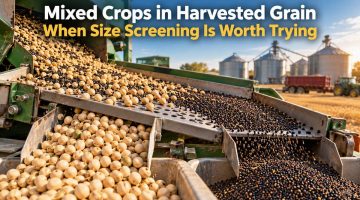
Two crops mixed after harvest? Can you separate them by seed size?
Mixed Crops in Harvested Grain: When Size Screening Is Worth Trying
USDA forecasts a national season-average price. Your local elevator offers a cash bid for a particular delivery period.
Why Your Corn Cash Bid Differs From USDA’s Forecast
Asian copperleaf is a newly reported weed threat in Minnesota. UMN Extension documented a discovery in a Rice County cornfield in fall 2025.
Green Patches After Harvest? How to Recognize Suspected Asian Copperleaf
Lady beetles help suppress aphids. Their presence alone doesn't determine whether your crop needs treatment.
Lady Beetles on the House Can Still Help Your Soybeans
AI-generated illustration of dry soybean pods remaining below the cut on soybean stubble, with loose yellow soybeans on the soil and mature soybean rows behind.
Soybeans on the Ground? Find the Loss Before Adjusting Your Combine
How Much Manure Does Your Corn Need? Minnesota's Updated 2026 Rates
How Minnesota Farmers Should Adjust Manure Rates Under Updated 2026 Guidelines
User-supplied article cover.
Dry Corn: Shell the Cob Without Breaking More Kernels
Why Green Pods Can Cause Storage Trouble in Dry-Testing Soybeans
User-supplied article cover.
Can Wet Corn or Soybeans Finish Drying in a Grain Bag?
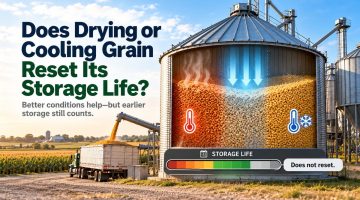
Cutaway view of a grain storage bin showing warm, moist grain on one side and cooler, drier grain on the other, with airflow arrows illustrating cooling. A storage-life indicator highlights that drying and cooling slow grain deterioration but do not reset the storage life already used. A grain truck and farm silos appear in the background.
Does Drying or Cooling Grain Reset Its Storage Life?
Comparison of soybeans at 13% and 9% moisture on weighing scales, illustrating how overdrying reduces saleable grain weight and farmer revenue even without a moisture discount. Soybean fields, a combine harvester, and grain storage elevators appear in the background.
Why Overdry Soybeans Can Bring a Smaller Check Without a Moisture Discount
User-supplied article cover.
Why Corn Can Stay Wet on Top While Drying Below
User-supplied article cover.
Keep Scabby Wheat Separate From Field to Bin
AI-generated illustration of a soybean load in a grain trailer with a hand holding an unmarked settlement slip beside the grain, suggesting a decision about cleaning before sale.
Should You Clean That Discounted Grain Lot Before Selling?
Illustration of an open sample jar and spilled soybeans with varied seed-coat colors on a grain-handling bench, suggesting a color-sorting question rather than an actual test result.
Color Sorter Results Changed? Look Beyond Sensitivity
AI-generated illustration of a farmer in a baseball cap talking on a phone and reviewing paperwork beside an open bulk bag filled with yellow soybeans.
Paying for Grain Cleaning? When Your Own Cleaner Makes Sense
AI-generated illustration showing a tight photographic-style close-up of dry green field peas, with round exit holes, broken-open hollowed seeds, and a small cream-colored larva inside one opened pea, mixed with intact peas.
Can ADS Cleaning Recover Good Peas From a Weevil-Damaged Lot?
What Comes With Your Metra Optical Sorter?
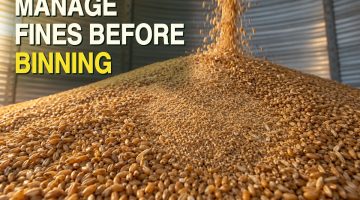
AI-generated photorealistic illustration of wheat falling onto a mound inside a grain bin, with a subtle concentration of finer grain material near the mound’s center.
Manage Fines Before Storing Wheat and Barley
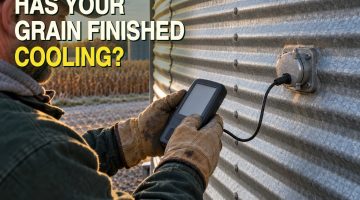
AI-generated illustration of a farmer in a baseball cap checking a handheld reader from ground level beside a grain bin on a crisp fall morning, representing stored-grain cooling checks.
Has Your Stored Wheat or Barley Finished Cooling?
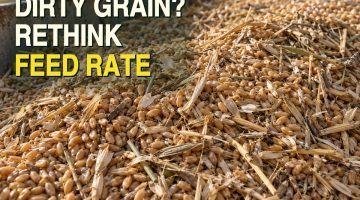
AI-generated illustration of wheat mixed with loose husks and short straw fragments in a worn metal receiving bin, shown in a sunlit close-up.
Dirty Grain: Balancing ADS Feed Rate and Airflow
AI-generated photorealistic illustration of intact pale-yellow and tan soybeans piled on a weathered pickup tailgate, with a harvested field blurred behind them.
Which Borderline Soybeans Should Stay After Color Sorting?
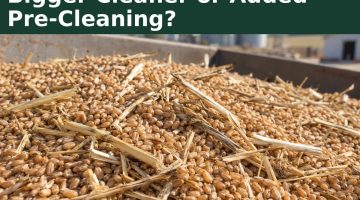
AI-generated photorealistic illustration of incoming wheat mixed with long dry straw fragments in a plain farm receiving hopper.
GPC Pre-Cleaning or a Larger ADS? Buy the Function Your Grain Needs
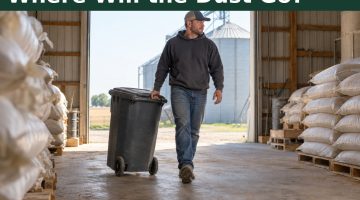
AI-generated illustration of a farmer wearing a baseball cap rolling a closed, unmarked waste bin through a grain-storage shed toward an open doorway, with grain sacks on pallets nearby.
Where Does the Dust Go? What a Cyclone Adds to Metra ADS
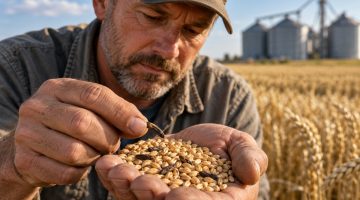
AI-generated illustrative image of a farmer in a baseball cap inspecting wheat with dark elongated fragments. Not a photograph of a customer or a Metra test.
Should I try an optical color sorter for ergot in my wheat?
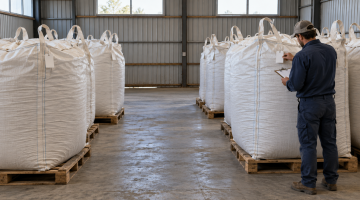
Illustration of a warehouse worker checking a lot tag beside separate groups of bulk bags.
Soybean Cleaner Changeovers: Keep Contract Lots Traceable
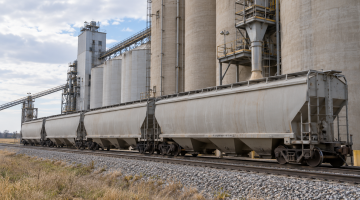
Illustration of covered grain hopper railcars beside a concrete grain elevator.
Corn Cleaning Before Export: Where to Place the Cleaner
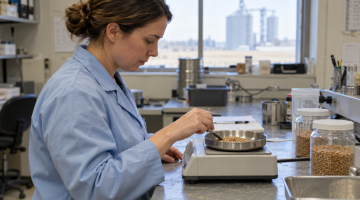
Illustration of a laboratory technician preparing a wheat sample at a bench.
Wheat Cleaning for Low Falling Number: What to Test
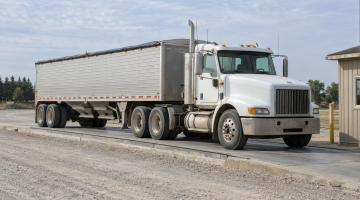
A white semi truck with a silver hopper-bottom grain trailer on a truck scale beside a weighing office.
Grain Cleaning Break-Even: Count the Grain You Keep
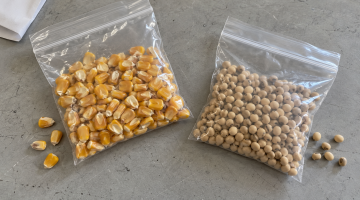
Separate clear sample bags containing yellow dent corn and tan soybeans on a grey work surface.
Corn and Soybean Samples: Decide What Needs Cleaning
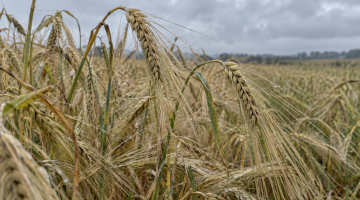
Drooping ripe barley heads with long awns and rain droplets in a field under an overcast sky.
Barley After Rain: What Cleaning Can Separate
Wheat ears and a tray of wheat kernels beside a harvested field under cloudy skies.
Rain-Delayed Wheat in North Dakota: When Is an Aerodynamic Grain Cleaner Worth Testing?
Round whole yellow field peas and thick split pea halves on a dark surface.
Cleaning Field Peas with an Aerodynamic Grain Cleaner: Splits and Light Damaged Peas
Fall Seed Treatment: Why Treat Seed Before Spring Planting
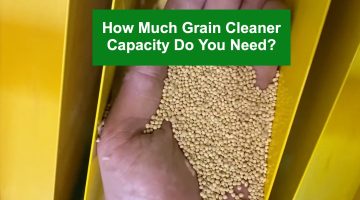
How Much Grain Cleaner Capacity Do You Actually Need?
Own Grain Cleaner vs. Outsourcing Grain Cleaning: Which Is Better for Your Farm?
Is Grain Cleaning Worth It or Just a Waste of Time?
Spring Planting Checklist: What to Verify Before the First Acre
Grain Cleaner Comparison by Type: Which System Is Right for Your Farm?
Grow More, Earn More – How Metra’s Technology Fuels Farm Expansion & Higher Margins
How Metra Grain Cleaning Machines Help Farmers Save Money and Boost ROI
Optical color sorters: What they are, how they work, and why farmers need them
Grain Cleaning Before Storage: How to Protect Your Harvest, Your Income, and Your Market Control
Baner 7 Metra Grain Cleaner Farm Roundup | October 1–15, 2025
Farm Roundup | October 1–15, 2025
The Harvest Paradox: When Abundance Becomes a Crisis
Farm Roundup | September 15-30, 2025
farm roundup Metra Grain Cleaner
Farm Roundup | September 1-15, 2025
Upgrading Science, Expanding Horizons
Upgrading Science, Expanding Horizons: The Impact of USDA NIFA’s Equipment Grants
Farm Roundup | August 15-31, 2025
Farm Roundup August 1-15, 2025
Farm Roundup | August 1-15, 2025
Farm Roundup | July 15–31, 2025
USDA Equipment Grants_ Up to 500,000 for Agricultural Machinery in 2025
USDA Equipment Grants: Up to $500,000 for Agricultural Machinery in 2025
Farm Roundup | July 1–15, 2025
Farm Roundup | June 15–30, 2025
Top USDA Grants and Funding Programs for U.S.
Top USDA Grants and Funding Programs for U.S. Wheat, Corn, Soybean, and Rice Farmers in 2025
Farm Roundup | June 1–15, 2025
Farm Roundup | May 15–30, 2025
Why Your Grain Loses Value—And How a Modern Grain Cleaner Can Fix It Fast
5 Hidden Costs of Outdated Grain Cleaning Equipment
5 Hidden Costs of Outdated Grain Cleaning Equipment—and How to Stop the Bleeding
Cleaner Grain—Cleaner Planet
Cleaner Grain—Cleaner Planet: How Modern Grain Cleaners Help Cut Waste
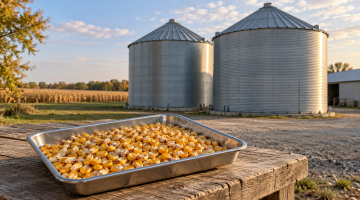
A tray of corn kernels with some chaff in front of metal grain storage bins.
Grain Cleaning Before Storage: Fines, Airflow and Lot Checks
how grain cleaning affects the profit of a farm
How Grain Cleaning Affects Farm Profitability
How Compact Aerodynamic Grain Drying
How Compact Aerodynamic Grain Drying Units Will Make Your Agribusiness Profitable
Fusarium How It Impacts Grain Quality and Safety
Fusarium: How It Impacts Grain Quality and Safety
Grain Cleaning Machines Why Clean Seed Means Better Crops
Grain Cleaning Machines: Why Clean Seed Means Better Crops
Why Grain Cleaning Machines Are Essential for Wheat Farmers
From Seed to Sale: Why Grain Cleaning Machines Are Essential for Wheat Farmers
How to Improve Grain Quality and Reduce Losses
Corn Cleaning Machines: How to Improve Grain Quality and Reduce Losses
Soybean Cleaners
Soybean Cleaners: The Secret to Better Seed Quality and Higher Yields
Why Investing in a Grain Cleaner Pays Off Quickly
plastic color sorting machine
How to Sort Plastic with Sixth-Generation Innovative Color Sorters
rice sorting machine
How to choose the best rice color sorting machine?
All-in-One Grain Cleaning: Solutions for Large and Small Farmers
Why Aerodynamic Grain Cleaning Is the Future of Farming
Grain Cleaning For Specific Crops: Maximizing Quality And Yield
How to Protect Your Grain From Toxins and Mold Fungi
How Sustainable Practices are Revolutionizing Farming in the U.S. and Canada with Metra Grain Cleaners
Innovative Grain Cleaning Solutions for Small-Scale Farmers
Metra Optical Color Sorters: Enhancing Grain Quality with Precision Technology
Investing in Metra’s Grain Cleaners
The Economic Impact of Investing in Metra’s Grain Cleaners
Overcoming Common Challenges with Metra’s Innovative Solutions
Revolutionize Your Grain Cleaning with Metra's Advanced AI-Driven Color Sorters
Grain Cleaning Protects Your Crops
How Quality Grain Cleaning Protects Your Crops from Pests and Diseases
Grain Cleaning Techniques for High Yields and Long-Term Storage
Important and Effective Grain Cleaning Techniques for High Yields and Long-Term Storage
Top Features to Look for in Air Recycling Aspirators
The Metra Air Recycling Aspirator – Efficiency and Innovation in Action
5 Ways Air Recycling Aspirators Improve Your Grain Quality and Safety
The Guide to Air Recycling Aspirators: Enhancing Grain Cleaning Processes
Different Types of Grain Cleaners: From Basic to Advanced Systems
A Comprehensive Guide to Using Grain Cleaners for Efficient Farming
Grain Cleaner for Corn.
Grain Cleaner Machines for Corn: Best Practices
The Importance of Clean Grain: Benefits of Using Grain Cleaners
Understanding Grain Cleaners: How They Work and Their Importance in Agriculture
Celebrating a Decade of Dedication and Love
Celebrating a Decade of Dedication and Love: Metra's Journey of Success
Metra Grain Cleaners Triumph: Customers voices
Get your $500 Metra-dollars bonus
Operation Scheme of Scalper Grain Cleaner Metra SGC-400
Metra Color sorter - sorting Hemp seeds
Metra color sorter is the best way to clean ergot in durum wheat.
Metra ADS 200-CDC cleaning IDK wheat
New Farm Toy - The Best Grain Cleaner for Farm Business | Metra ADS and Metra CDC
Real experience using grain cleaning machines Metra ADS 2000 & ADS 4000
New grain cleaners already in stock
Metra grain cleaners - technical features. What are the differences?
Beware of fakes: the real Metra is inexpensive!
Why does a farmer need Metra?
METRA GRAIN CLEANER. Top Most Agricultural Technology Inventions.
The Grain Cleaner Metra
These Grain Cleaner Machines Consume Less Power Maintaining Productivity

With Metra grain cleaners you:

Get a return on your investment the very 1st season — in some cases even in a few days!
Clean your own grain and get the top dollar for your harvest.
Get an innovative grain cleaner that is more efficient than analog models.