Production and sale of grain cleaning equipment worldwide
Soybeans on the Ground? Find the Loss Before Adjusting Your Combine
26 October 2026
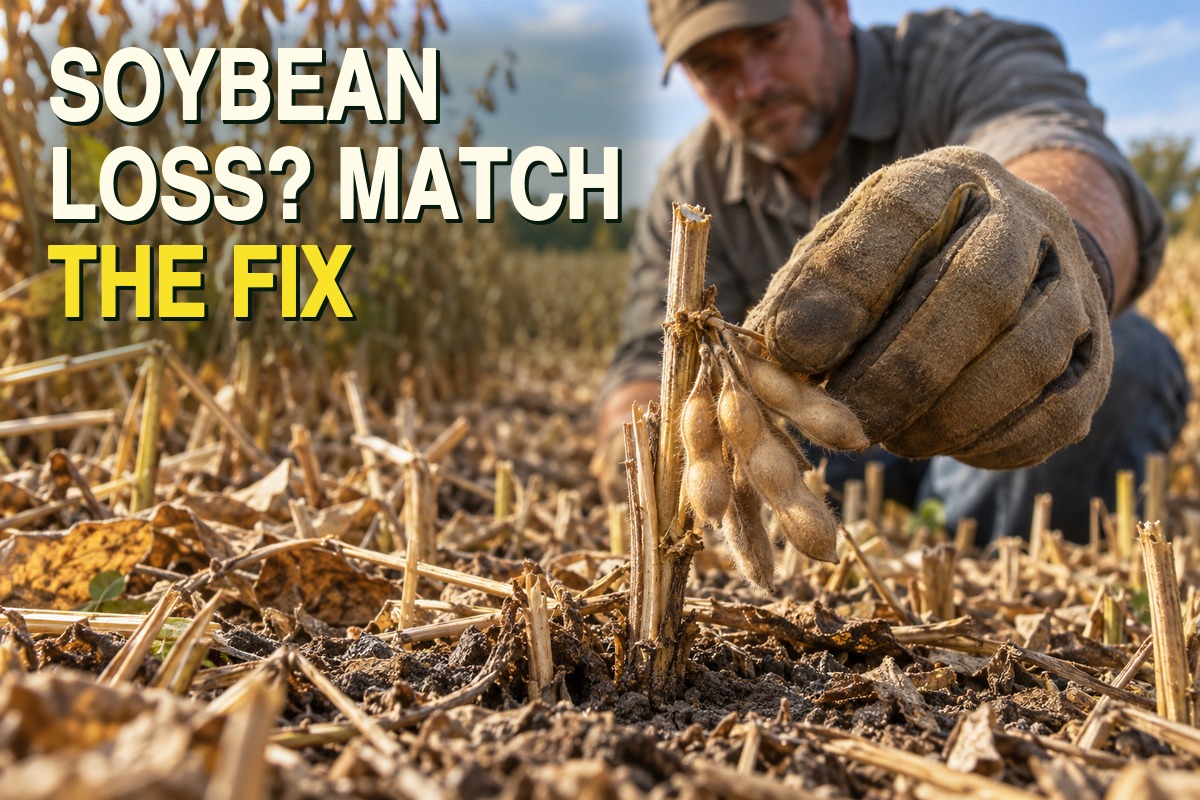
Finding the kind of soybean loss makes the next adjustment more useful. Pods left below the cut call for a different response than beans scattered by the header. Separate those losses from beans already on the ground and grain discharged out the rear, then adjust the cutting or reel action responsible.
Look in three places before changing settings
Before adjusting your combine, find out where the soybeans are being lost. Check several representative locations across the field, using the same-sized sampling areas for comparison.
1. Before the header: establish your baseline.
Check the standing crop before combining. Count loose beans and beans in shattered pods on the ground. These are preharvest losses—the combine did not cause them.
2. After the header: identify cutting and gathering losses.
Inspect ground the header has crossed but rear discharge has not covered. Iowa State Extension explains how stopping during a pass and backing up can expose this area.Compare the bean count with your preharvest baseline. Any increase indicates additional loss during cutting or gathering. Also look for pods still attached to cut stem bases.
3. Behind the combine: inspect discharged material.
Check loose beans and beans remaining in pods among the discharged residue. These may indicate threshing or separation losses. Remember that beans found behind the combine can also include preharvest and header losses. Do not attribute the entire count to the rear of the machine.
How much is one bushel per acre?
Iowa State Extension provides a useful field rule of thumb:
4 soybean seeds per square foot ≈ 1 bushel per acre of loss.
For example, an average of eight beans per square foot represents approximately two bushels per acre of total loss in the sampled area. To estimate header-related loss, first subtract the preharvest baseline. This is an approximate field estimate, not an exact measurement. Sample several locations before deciding whether an adjustment is working. Follow the operator's manual for safe parking, shutdown, inspection and adjustment. Complete all repositioning before approaching an inspection area, wait for moving parts to stop, and never go beneath an unsupported header.
Pods left on stubble point to the cut
If pods remain attached below the cut, compare cutting height with the lowest pods in that field. The reel cannot gather pods the cutterbar leaves on the stem base. University of Minnesota Extension’s soybean harvest guidance specifically calls for checking that relationship.
If stems are being pushed or cut poorly, check the cutterbar rather than simply lowering the header. Sharp knife sections, a close knife-to-guard fit and correct cutterbar register—the knife’s alignment with the guards—help the cutting parts shear stems properly. Make inspections and repairs according to your manual.
Travel speed matters here, too. If the combine is outrunning the cutterbar, reduce ground speed so it can cut the stems instead of shearing pods off them. These are the cutting checks emphasized in Iowa State’s combine adjustment guidance.
### Field example: Is the header costing you a bushel per acre?
Suppose you check several representative locations and find:
– **Before combining:** 1 soybean per square foot.
– **After the header passes:** 5 soybeans per square foot.
The additional loss is:
**5 − 1 = 4 soybeans per square foot.**
Using Iowa State Extension's field estimate, that represents approximately **1 bushel per acre of additional header loss**.
Now identify the cause.
If pods remain attached to cut stubble, inspect cutting height and cutterbar performance. If loose beans have increased but the pods are being cut and gathered, investigate reel speed, reel position and pod shattering. Make one adjustment, harvest another comparable section, and repeat the count.
For example, if the average falls from five beans to three per square foot while the preharvest baseline remains one, the estimated header loss has dropped from about one bushel to half a bushel per acre.
That comparison helps you judge whether the adjustment improved harvesting performance rather than relying on appearance alone.
*These numbers are illustrative. Actual losses vary with field conditions, crop characteristics and sampling accuracy.*
Newly scattered beans point toward shatter
More loose beans in the header-only area than in the standing crop point toward shatter during gathering. When header shatter is high, try reducing reel speed—but not so far that stalks begin to drop instead of feeding onto the platform.
For standing soybeans, Iowa State’s September 9, 2026 guidance gives reel speed approximately 25% faster than ground speed as a starting point, with the reel working in the upper third of the plants. Judge that starting point by feeding and loss in your crop; short or lodged plants need different attention.
For short plants, lowering the reel may help gather them. Iowa State’s 2023 guidance specifies keeping at least two inches between the reel finger tips and the flexible cutterbar at its highest position. Follow the instructions for your particular header and reel when checking clearance.
Make the next pass answer one question
Before changing your combine settings:
Count: Check loose soybeans in several 1-square-foot areas before and after the header passes.
Identify: Are you leaving pods on stubble, shattering beans at the header, or losing beans through the rear?
Adjust: Match one setting to the problem—cutting height, cutterbar condition, ground speed, or reel speed and position.
Compare: Repeat the same check after adjusting. Did the loss decrease?
As a rule of thumb, four soybeans per square foot represent approximately one bushel per acre of loss.
The goal isn't simply fewer beans on the ground. It's knowing where they're being lost and correcting the cause.