Production and sale of grain cleaning equipment worldwide
Is Grain Cleaning Worth It or Just a Waste of Time?
3 June 2026



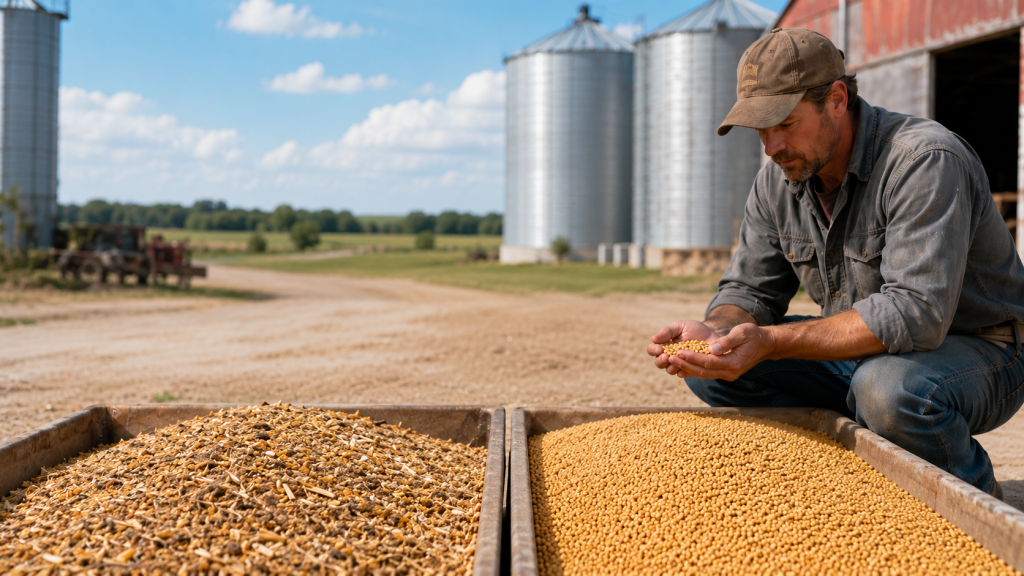
After harvest, many farmers face the same question: should I spend extra time cleaning grain, or should I move it straight into storage and deal with it later?
At first, skipping grain cleaning can look like a practical decision. Harvest is busy, labor is limited, and every extra operation takes time. But in many cases, this “shortcut” creates hidden losses later: dockage penalties, rejected loads, storage spoilage, price deductions, and lost grain value.
Grain cleaning is not just about making grain look better. When done for the right purpose, it becomes part of post-harvest cleaning, storage protection, quality control, and value recovery.
The real question is not “Should every lot be cleaned as much as possible?” The better question is: what level of grain cleaning does this crop need, and will the result protect more value than it costs?
A grain cleaner is not just another machine in the yard. It can be the difference between selling grain with deductions and selling a cleaner, more valuable crop.
Why Farmers Question Grain Cleaning After Harvest
The hesitation is understandable. Grain cleaning requires an extra step. It may require a grain cleaning machine, labor, energy, handling time, and proper setup. If the grain already looks “good enough,” cleaning can feel unnecessary.
But grain is rarely just grain after harvest. A typical lot may contain:
- broken kernels;
- light or damaged kernels;
- fines and dust;
- weed seeds;
- chaff and straw;
- stones or other foreign material;
- insect-damaged grain;
- mold-affected or visually damaged kernels.
Some of this material affects market grade. Some affects storage. Some affects seed quality. Some increases handling problems. And some may contribute to contamination risk if the crop is stored under poor conditions.
That is why agricultural grain cleaning should not be viewed as a cosmetic operation. It is a practical decision about risk, crop value, and profitability.
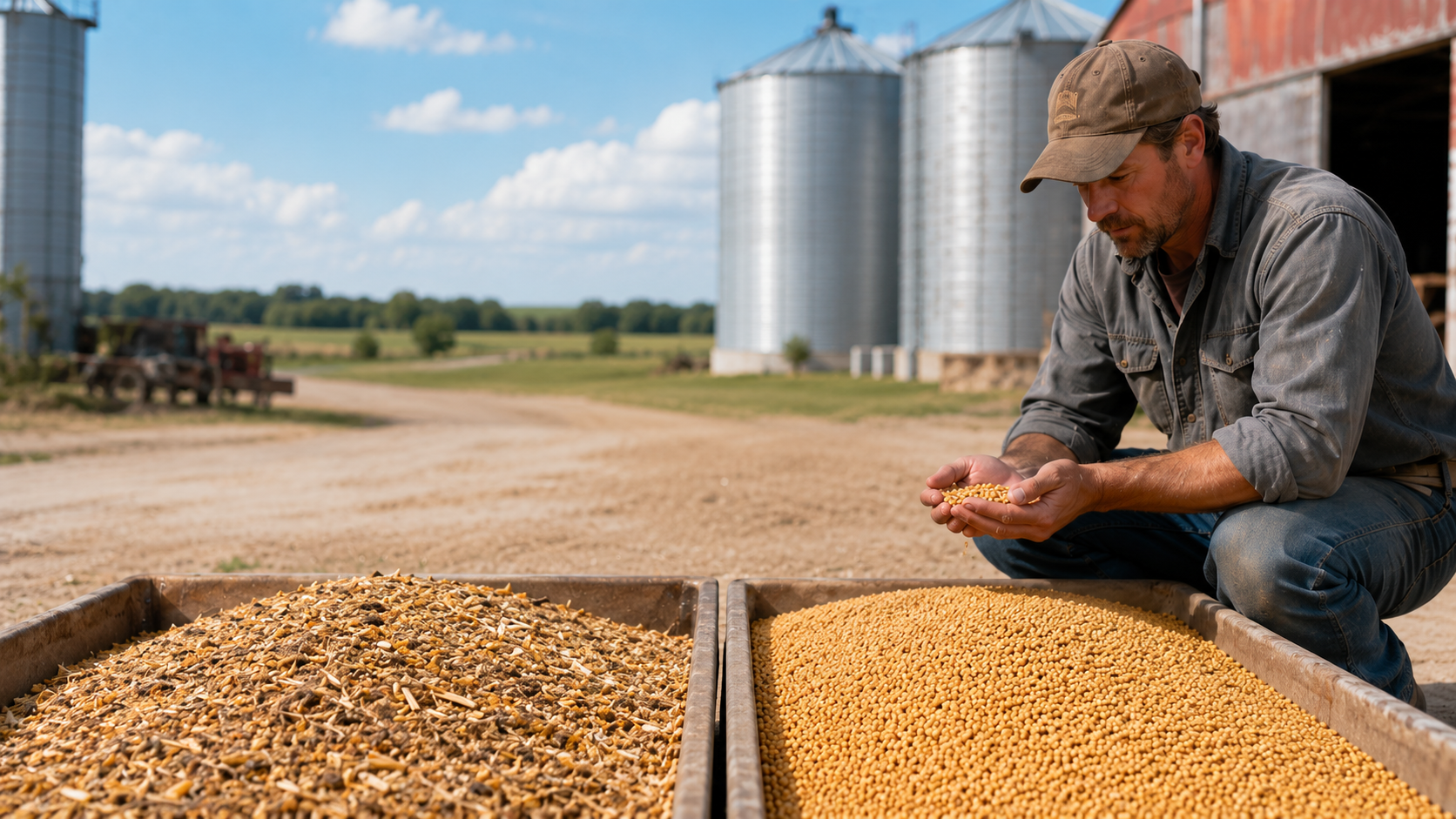
For example, a wheat lot with excess fines may cool unevenly in storage and face dockage deductions at delivery. A soybean lot with damaged or lightweight kernels may lose value with premium buyers. A seed lot with weed seeds and uneven kernel size may reduce field performance the following season.
A properly selected grain cleaner can help remove the fractions that cause these problems later. The value depends on the crop, contamination level, storage plan, buyer requirements, and whether the grain will be sold, stored, processed, or used as seed.
The Common Mistake Farmers Make
Many farms underestimate the storage cost of dirty grain until losses appear later.
The grain may look acceptable at harvest. The bin may fill quickly. Everything may seem fine for the first few weeks. But later, hidden problems can show up as hot spots, mold, insects, poor airflow, spoiled grain, or unexpected dockage penalties when the load is finally delivered.
This is the common mistake: looking only at the visible cost of cleaning and ignoring the invisible cost of not cleaning.
The visible cost is easy to see:
- extra handling;
- machine time;
- labor;
- fuel or electricity;
- setup and adjustment.
The hidden losses are often harder to measure:
- revenue loss from price deductions;
- rejected loads;
- reduced market access;
- lost premium opportunities;
- storage spoilage;
- lower seed performance;
- reduced crop value.
Even small dockage reductions can protect crop value during sale. Even small improvements in storage stability can prevent larger losses later. That is why grain cleaning is often less about “spending time” and more about protecting the value already grown in the field.
What Happens When Grain Is Stored Without Cleaning?
The biggest mistake is thinking that grain only needs cleaning before sale. In reality, the storage period is often where dirty grain becomes expensive.
Foreign material, fines, and broken kernels do not distribute evenly in a bin. They can collect in dense zones, reduce airflow, and create conditions where heat and moisture are harder to manage. That matters because storage quality depends heavily on airflow, cooling, drying, and stable conditions inside the grain mass.
Fines and Foreign Material Restrict Airflow
Clean grain allows air to move more evenly through the bin. Dirty grain does the opposite.
Fines, dust, broken kernels, and weed seeds can block air channels. When airflow is uneven, some zones cool and dry properly while others remain warm or moist. These areas can become hot spots, increasing the risk of mold development, insect activity, and spoilage.
This is one of the strongest arguments for grain cleaning before storage. Even a basic pre-cleaning step can make storage management easier by removing the light and fine material that causes airflow problems.
For farms that store grain for weeks or months, the cost of skipping cleaning may appear later as:
- longer fan runtime;
- uneven cooling;
- more spoilage risk;
- harder bin management;
- quality loss before sale;
- lower final crop value.
In other words, grain cleaning is not only about the grain cleaner itself. It can also reduce the downstream cost of storage and aeration.
Mold, DON, Aflatoxin, and Contamination Risk
Grain cleaning cannot “fix” contaminated grain completely. It does not replace drying, cooling, sampling, or proper storage management.
However, cleaning can help reduce risk by removing fractions that are more likely to carry problems: fines, broken kernels, lightweight infected kernels, dust, moldy material, and damaged grain.
This is especially important when dealing with issues such as:
- DON / vomitoxin;
- aflatoxin;
- fusarium;
- mold;
- ergot;
- insect-damaged kernels.
A grain cleaner can help reduce part of the contamination load by separating higher-risk material from the main grain lot. But it is important to be honest: grain cleaning reduces risk; it does not guarantee that toxins are fully removed.
Cleaning reduces risk, but testing is still necessary.
This message matters because it builds trust. The right grain cleaning machine can help reduce mold-related risk and remove damaged fractions, but testing is still required when DON, aflatoxin, or other mycotoxins are a concern.
The best approach is usually a combination of cleaning, drying, cooling, and testing.
When Grain Cleaning Actually Makes Money
Grain cleaning becomes profitable when it protects or increases the value of the crop more than it costs to run the operation.
That value can come from several areas: fewer deductions, better storage, higher seed quality, better market access, and more control over the crop after harvest.
Lower Dockage and Fewer Price Deductions
Dockage is one of the most direct ways dirty grain turns into lost revenue.
If a buyer finds removable foreign material, weed seeds, broken kernels, or other unwanted fractions, the farmer may receive a lower price, face deductions, or even risk rejection depending on the buyer’s standards.
Cleaning grain before delivery can help reduce these deductions by removing material that does not belong in the final product.
This matters especially when selling to:
- elevators;
- processors;
- feed mills;
- seed buyers;
- specialty crop buyers;
- premium grain markets.
A grain cleaner can help farmers shift from “selling whatever came out of the field” to “selling a more controlled, higher-quality product.”
That does not mean every lot will automatically earn a premium. But it does mean the farmer has more control over quality before the buyer makes the final judgment.
Even small dockage reductions can protect crop value during sale. For high-volume operations, a small difference per bushel can become a meaningful profitability factor across the whole season.
Better Storage and Less Spoilage Risk
Storage losses are often less visible than dockage deductions, but they can be just as important.
Dirty grain may store poorly because of uneven airflow, higher mold risk, and concentration of fines. If the crop heats, molds, or loses condition in storage, the farmer may lose far more than the time it would have taken to clean it earlier.
For grain going into longer-term storage, cleaning is often easier to justify. The longer the storage period, the more important stable grain condition becomes.
In this situation, a grain cleaning machine is not just processing equipment. It becomes part of the farm’s storage strategy.
Better Market Access
Clean grain can also support better market access.
Some buyers are more sensitive to dockage, foreign material, damaged kernels, mold risk, or visual quality. If the crop is too dirty, the farmer may lose access to premium buyers and be forced into lower-value markets.
That is where grain cleaning becomes value recovery. It helps protect the part of the crop that has already been grown, harvested, dried, and transported.
A cleaner lot may support:
- fewer price deductions;
- fewer claims;
- better buyer confidence;
- access to higher-value channels;
- improved reputation with repeat buyers.
The cleaner the final product, the more flexibility the farm has when choosing where and how to sell.
Stronger Seed Quality
If the grain will be used as seed, the value of cleaning becomes even more obvious.
Seed cleaning equipment helps remove:
- weed seeds;
- cracked and damaged kernels;
- lightweight seeds;
- undersized material;
- inert matter;
- diseased or poor-quality fractions.
Cleaner seed can improve planting consistency, flow through equipment, and crop establishment. It can also reduce the risk of spreading weed seeds back into the field.
For seed use, the goal is not simply “clean grain.” The goal is a more uniform, viable, plantable seed lot.
Uniform seed quality matters because seeds that are closer in size, weight, and vigor tend to emerge more evenly. More even emergence helps reduce competition between early and late seedlings, supports more consistent plant development, and can make crop management and harvesting easier.
When seedlings start at very different times, smaller or weaker plants may be outcompeted by stronger ones. That can affect stand uniformity and final yield potential. A cleaner, more uniform seed lot gives the crop a better start.
That is why a seed cleaning system is a separate and important use case. A farmer preparing wheat, soybeans, oats, barley, peas, or other crops for planting needs to think about purity, germination, uniformity, seed flow, and field performance — not only visual cleanliness.
When Grain Cleaning May Not Be Worth It
A balanced answer matters. Grain cleaning is valuable in many situations, but it is not always worth doing at the same intensity.
Cleaning may be less justified when:
- the lot is already very clean;
- the grain will be sold immediately with no storage period;
- the buyer does not reward higher cleanliness;
- contamination is not removable by mechanical separation;
- cleaning would remove too much good grain;
- the farm has no clear goal for the cleaning process.
The key mistake is over-cleaning without a purpose.
For example, a lightly contaminated lot that will move quickly into a low-spec feed market may not need the same cleaning level as seed wheat, food-grade grain, or a crop going into long-term storage.
This is why the best question is not “Do I need cleaning or not?” It is: what problem am I trying to solve?
A farm may need:
- basic pre-cleaning before storage;
- deeper grain cleaning before sale;
- seed cleaning before planting;
- density separation for light and damaged kernels;
- optical sorting for visual defects;
- a multi-stage grain cleaning system for complex contamination.
Different goals require different grain separation equipment.
Pre-Cleaning vs. Deeper Grain Cleaning
Not all cleaning is the same.
A basic pre-cleaning step is usually focused on removing large foreign material, dust, chaff, and fines before storage or before deeper processing. It helps reduce load on later equipment and improves storage conditions.
Deeper grain cleaning may involve several stages, depending on the crop and target quality:
- air separation;
- screen separation;
- density separation;
- aspiration;
- optical sorting;
- calibration by size;
- separation of light or damaged kernels.
This is where the choice of grain processing equipment becomes important.
A simple cleaner may be enough for some farms. Others may need an aerodynamic grain cleaner, vibration cleaner, aspirator, optical color sorter, destoner, or a combined grain cleaner kit.
The right choice depends on the crop, contamination profile, capacity requirements, and final use of the grain.
Comparison: Which Cleaning Method Fits the Problem?
Different grain cleaning systems solve different problems. Choosing the wrong method can waste time. Choosing the right one can protect crop value.
| Problem | Recommended cleaning method | Why it works |
| Large foreign material, straw, chaff | Pre-cleaning | Removes rough impurities before storage or deeper processing |
| Dust, fines, light material | Aspiration / air separation | Improves airflow and removes light fractions |
| Oversized or undersized kernels | Screen cleaning | Separates material by size |
| Lightweight or damaged kernels | Aerodynamic separation | Separates by density and aerodynamic behavior |
| Moldy-looking or discolored kernels | Optical sorting | Detects visual defects by color or appearance |
| Stones and heavy impurities | Destoning | Removes dense foreign material |
| Seed preparation | Seed cleaning system | Improves purity, uniformity, and planting quality |
| Mixed contamination | Multi-stage grain cleaning system | Combines several methods for better results |
This comparison is important because no single cleaning principle solves every problem equally well.
Screens are strong for size separation.
Aerodynamic systems are strong for density separation and light or damaged kernels.
Optical sorting is strong for visible defects.
Aspirators are strong for dust and light impurities.
The best result often comes from matching the cleaning method to the actual contamination problem.
Why Aerodynamic Grain Cleaning Has an Advantage
Aerodynamic grain cleaners can separate lightweight and damaged kernels without constant screen changes.
This is a major practical advantage for farms that work with multiple crops or changing contamination profiles. Instead of relying only on screens, aerodynamic separation uses airflow and kernel behavior to separate grain by relative density and aerodynamic properties.
That means aerodynamic grain cleaning can be especially useful when the issue is not just size, but kernel quality.
For example:
- light kernels can be separated from heavier, healthier grain;
- damaged kernels can be removed more effectively;
- some mold-affected or low-density fractions can be reduced;
- different crops can be processed with more flexibility;
- setup can be simpler when moving between crops.
This is where Metra’s aerodynamic separation advantage becomes important.
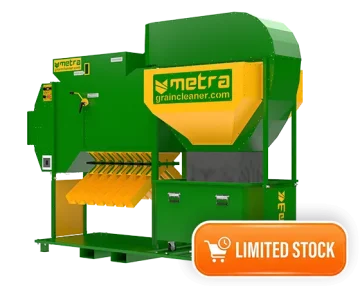
Metra aerodynamic grain cleaners are designed for farms that need multi-crop flexibility, density separation, and low-maintenance operation. Unlike screen-based systems that often require screen changes for different crops or sizes, aerodynamic cleaners help reduce setup time and simplify operation across different grain types.
Key advantages include:
- no constant screen changes;
- multi-crop flexibility;
- density separation;
- separation of light and damaged kernels;
- low maintenance;
- practical use for post-harvest cleaning;
- strong fit for farms handling different crops through the season.
For operations that clean wheat, corn, soybeans, oats, barley, peas, lentils, or other crops, this flexibility can save time and improve consistency.
What Type of Grain Cleaner Fits Each Task?
There is no universal grain cleaner that is perfect for every farm and every crop. Different machines solve different problems.
Pre-Cleaners
Pre-cleaners are useful when the main goal is to remove large impurities, straw, chaff, dust, and lighter material before storage or before deeper processing.
They are often the first step in a grain cleaning line.
Best for:
- basic cleaning after harvest;
- reducing load on other machines;
- preparing grain for storage;
- removing rough foreign material.
Aerodynamic Grain Cleaners
Aerodynamic grain cleaners are designed to separate grain by airflow behavior, density, and kernel condition. They can remove lightweight and damaged kernels without constant screen changes, which makes them practical for farms that work with multiple crops.
Best for:
- removing light impurities;
- separating damaged kernels;
- improving grain quality;
- reducing part of mold-related risk;
- working with different crops;
- reducing setup time compared with screen-only systems.
This type of grain cleaner can be especially useful when the problem is not only size, but weight, density, and kernel condition.
Vibration Grain Cleaners
Vibration cleaners use screens and vibration to separate material by size. They are effective when the main difference between good grain and impurities is physical size.
Best for:
- size separation;
- calibration;
- removing oversized or undersized material;
- preparing more uniform lots.
Aspirators
Aspirators use airflow to remove light impurities, dust, and chaff. They can work as part of a larger system or as a supporting cleaning stage.
Best for:
- dust removal;
- light material separation;
- improving airflow-related cleanliness;
- supporting other grain cleaning equipment.
Optical Color Sorters
Optical color sorters separate kernels based on visual differences. They are useful when defects can be identified by color or appearance.
Best for:
- ergot;
- discolored kernels;
- moldy-looking kernels;
- visually damaged grain;
- premium quality sorting.
Multi-Stage Grain Cleaning Systems
When the grain lot has several problems at once, a single-stage machine may not be enough.
For example, a crop may contain dust, light damaged kernels, weed seeds, stones, and visually defective kernels. In that case, a multi-stage system can be more effective than relying on one machine.
This is where grain cleaner kits and combined systems become practical.
The Real Cost of Not Cleaning Grain
The cost of grain cleaning is visible: equipment, time, labor, setup, and energy.
The cost of not cleaning is often hidden.
It may show up as:
- lower sale price;
- dockage penalties;
- price deductions;
- rejected loads;
- storage spoilage;
- longer aeration time;
- poor seed performance;
- more weed pressure;
- lower trust from buyers;
- missed premium opportunities;
- lost grain value.
This is why many farms only realize the value of cleaning after they compare the full cost, not just the immediate task.
If cleaning removes low-value material and protects the high-value portion of the crop, it is not wasted time. It is value recovery.
A grain cleaner does not create crop value out of nothing. It helps protect the value that is already there.
Mini ROI Framing: How Cleaning Protects Crop Value
ROI from grain cleaning does not always come from one big number. Often, it comes from several smaller improvements that add up.
For example:
- fewer dockage deductions at delivery;
- less grain rejected by buyers;
- better storage stability;
- lower spoilage risk;
- cleaner seed for planting;
- better access to premium buyers;
- more consistent product quality.
Even small dockage reductions can protect crop value during sale. Even small improvements in seed uniformity can support more consistent crop establishment. Even small reductions in storage spoilage can matter when the volume is large.
That is why grain cleaning should be evaluated as a crop value protection tool, not only as an equipment expense.
A Simple Way to Decide: Should You Clean This Lot?
Before running grain through a cleaner, ask these questions:
- Will this grain be stored for more than a short buffer period?
- Does the lot contain fines, dust, chaff, weed seeds, or broken kernels?
- Is airflow or drying efficiency important for this batch?
- Will the buyer apply dockage or quality deductions?
- Is the grain intended for seed?
- Is there a risk of mold, DON, aflatoxin, fusarium, or ergot?
- Could better cleaning open a higher-value market?
- Would cleaning remove mostly low-value material or too much good grain?
- Do you need size separation, density separation, or visual sorting?
- Are you processing multiple crops during the season?
If several answers are “yes,” grain cleaning is likely worth evaluating seriously.
If most answers are “no,” a lighter cleaning step or no additional cleaning may be enough.
Is Grain Cleaning Worth It?
In most practical farm situations, yes — grain cleaning is worth the time when the crop is going into storage, being sold by quality standards, or used as seed.
It helps remove material that creates problems later: fines, dust, weed seeds, broken kernels, light grain, damaged kernels, and foreign material. It can improve airflow, reduce storage risk, lower dockage, support better seed quality, and give the farmer more control over the final product.
But grain cleaning should be done with a clear goal. It is not about cleaning every batch as much as possible. It is about choosing the right level of cleaning for the crop, contamination, buyer requirements, and storage plan.
A grain cleaner is not just another machine in the yard. It is a tool for protecting crop value, reducing hidden losses, and improving profitability after harvest.
Need Help Choosing the Right Grain Cleaning Setup?
Every farm has a different grain cleaning challenge. Some need basic pre-cleaning before storage. Others need a seed cleaning system, aerodynamic separation, screen cleaning, aspiration, optical sorting, or a multi-stage grain cleaning system.
Metra Grain Cleaners help farmers clean different crops, reduce impurities, separate lightweight and damaged kernels, improve grain quality, and prepare grain for storage, sale, or planting.
Tell us your crop and contamination issue — we’ll recommend the right setup.
Send us your crop, contamination level, and target capacity for a custom recommendation.
tel: +17015150488
email: info@graincleaner.com