Production and sale of grain cleaning equipment worldwide
Grain Cleaning Break-Even: Count the Grain You Keep
24 September 2026
Grain cleaning breaks even when proceeds from the retained grain and any saleable secondary fraction, less the added costs, equal the original lot's net sale value. A higher price per bushel or tonne is only one input. You also need the quantity the buyer will pay for after cleaning.
Use an actual buyer offer for the calculation. Cleaning value depends on your lot's deductions, the accepted output and the delivery terms.
Start with the actual sale alternative
Ask what you would receive if you sold the lot in its present condition. Record the buyer, delivery period, payable quantity, price deductions and any charges that would apply. Use the expected net settlement as the baseline. Put the cleaned offer on the same basis: account for the buyer deductions and delivery charges included in that baseline, then list only the remaining added costs separately.
Then ask the buyer how a tested cleaned sample would be priced under comparable terms. A cleaner supplier can demonstrate the separation; the buyer determines the offer for the grain you intend to deliver.
Keep the basis calculation separate. Iowa State University Extension defines basis as local cash price minus the relevant futures price and explains that transport, storage and local supply and demand influence it. A gap between a reported cash bid and futures is therefore not a ready-made cleaning premium. Corn and Soybean Price Basis
If the offer after cleaning comes from another buyer or a later delivery month, show that change explicitly. Include the resulting transport, storage and other costs so the comparison remains useful.
Measure recovery before multiplying prices
Weigh the input and the retained product in a representative trial. Account for the other collected fractions and any missing material. The retained fraction is the starting point for the quantity you may be able to sell into the target market.
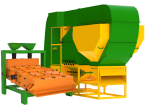
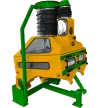
A METRA ADS aerodynamic grain cleaner uses airflow to separate physical fractions. Feed, airflow and collection adjustments affect that separation. A setting that produces a cleaner-looking sample can also send acceptable grain into another outlet. Evaluate the quality and quantity together. METRA ADS operating manual
Use the buyer's payable units in the revenue calculation. If dockage, moisture adjustments or other settlement deductions change paid weight, apply the actual rules to each route. Physical mass retained and payable quantity can differ.
For U.S. sales, use the buyer's bushel settlement basis for that crop. For Canadian sales, use metric tonnes where that is the quoted unit. Keep currency consistent. A test-weight reading is a quality measurement of mass per volume; it is not the amount of grain recovered from the cleaner.
A worked example in Canadian dollars
The following figures are hypothetical assumptions chosen to explain the calculation. They are not current market quotes, a METRA customer result or expected machine performance. Both routes use the same delivery and moisture basis, and there are no additional buyer weight deductions in this example.
Assume an original lot of 100 metric tonnes can be sold for CAD 260 per tonne. Its baseline proceeds are CAD 26,000. A trial is assumed to retain 94 tonnes for the target market. The removed material has no assumed sale value. Added cleaning, handling, testing and related costs total CAD 800.
| Scenario | Grain revenue | Added costs | Net proceeds | Change from original sale |
|---|---|---|---|---|
| Sell original 100 t at CAD 260/t | CAD 26,000 | CAD 0 | CAD 26,000 | CAD 0 |
| Retain 94 t and sell at CAD 290/t | CAD 27,260 | CAD 800 | CAD 26,460 | CAD 460 gain |
| Retain 94 t and sell at CAD 270/t | CAD 25,380 | CAD 800 | CAD 24,580 | CAD 1,420 loss |
The first cleaning scenario has a CAD 30-per-tonne price increase, but the lot gains only CAD 460 after the assumed loss of saleable mass and added costs. Applying the price increase to the entire original 100 tonnes would overstate the benefit.
The second cleaning scenario still receives more per tonne than the original lot. Its lower retained quantity and processing costs outweigh that increase.
Find the price needed to break even
For a fixed retained quantity, calculate:
Required cleaned price on the same net basis = (original net sale proceeds + incremental costs – net secondary-fraction proceeds) / retained payable quantity.
In the example, that is (CAD 26,000 + CAD 800 – CAD 0) / 94 t = approximately CAD 285.11 per tonne. The buyer's accepted cleaned-lot price must exceed that level for a positive operating benefit under these assumptions.
Secondary-fraction proceeds should be entered only when a suitable outlet and price are confirmed. Deduct associated costs once, either in that net value or in the cost total. Never assume rejected material is safe or saleable feed because it came from a grain cleaner.
The calculation already captures removed mass through the smaller retained quantity. Subtracting the full value of those same removed tonnes again would count that loss twice.
Include costs that actually change
Obtain a realistic total for electricity or fuel, labour, extra conveying, testing, wear, additional freight and disposal where relevant. Include repeat passes when the trial shows they are needed. A delay can also change the comparison if it adds storage charges or causes the lot to miss the intended delivery window.
Use the actual hauling charge or fuel use for your route. Count avoided custom-cleaning fees only if you would otherwise pay them.
The example reports a per-lot operating benefit before equipment ownership and financing costs. An equipment purchase requires a separate annual assessment of the volume likely to need cleaning, available hours, maintenance and ownership costs. One favourable sample does not establish annual payback.
Turn the trial into a buying decision
Ask for a record that links the sample, settings, retained quantity and buyer's assessment. Run the calculation again with a lower retained quantity, a smaller price improvement or a higher cost total. That shows how much room the proposal has before it stops paying.
The broader reasons to consider equipment are covered in Is Grain Cleaning Worth It?. For a particular lot, bring the decision back to its accepted output and net settlement.
Contact METRA with the crop, lot volume, original buyer offer and cleaning target. A demonstration with your grain can provide the physical recovery data needed for a useful break-even calculation.