


Production and sale of grain cleaning equipment worldwide
Farm Roundup | July 1–15, 2025
16 July 2025
Similar Equipment

ADS-200e
Learn more

SGC-400-H
Learn more

6AS-68
Learn more

6AS-68L Belt
Learn more

ADS-200
Learn more

ADS-200-CDC
Learn more

GPC-400
Learn more

MGC-800
Learn more

SGC-400
Learn more

STM-120
Learn more

VDSC-400
Learn more

6AS-136
Learn more

ADS-400
Learn more

ADS-400-CDC
Learn more

ADS-400GM-CDC
Learn more

GPC-2000
Learn more

STM-200
Learn more

6AS-204
Learn more

ADS-600-CDC
Learn more
Hi! Here is the ag news not to be missed from the last two weeks. Short, sharp, and straight. Ignore endless scrolling through articles and keep control with timely decision-making by reading the digest.
USDA Now Accepting Applications for Weather‑Related Ag Disaster Assistance
Starting July 10, 2025, USDA is accepting applications for the Supplemental Disaster Relief Program—a $16 billion aid package for farmers who suffered weather-related losses in 2023–2024. The first phase covers producers who already received insurance or NAP payments, with disaster payments set at 35% of insured losses. A second phase will launch in the fall for farmers with uninsured losses due to floods, droughts, fires, and similar events.
Why read this: This gives farmers immediate access to large payouts without needing new legislation—critical for recovery planning after extreme weather.
Trump Immigration Shake-Up Hits Farms, Hotels, Workers
https://www.nytimes.com/2025/07/02/us/politics/trump-undocumented-immigrants-farmers-hotels.html
President Trump acknowledged that strict immigration enforcement caused a 40–42% labor shortage in agriculture—a sector dependent on undocumented and seasonal labor. A temporary pause on ICE raids at farms and hotels in June 2025 led to a “strategic policy review,” but operations resumed soon after due to internal disputes within the administration.
Why read this: Sudden changes in immigration rules directly affect labor access, costs, and hiring strategy—especially for farms that rely on seasonal crews.
Farm Bankruptcies This Year Already Exceed 2024 Levels
https://www.agriculture.com/partners-farm-bankruptcies-this-year-already-exceed-2024-levels-11772290
In Q1 2025, U.S. farmers filed 259 bankruptcy cases—already surpassing the full total of 216 in 2024. Most cases fall under Chapter 12, designed specifically for family farms. Key drivers include falling commodity prices—back to 2018–2019 levels—and sharp increases in fertilizer and seed costs.
Why read this: This signals growing financial pressure that could limit access to credit—forcing farmers to rethink debt, cost control, and business continuity.
Farmers Could See Significantly Higher 2025 Crop Payments Under Trump’s Megabill
New projections suggest increased payments in 2025 under Price Loss Coverage (PLC) and Agriculture Risk Coverage (ARC), driven by the “One Big Beautiful Bill.” The legislation authorizes up to 30 million additional base acres to be counted toward payment eligibility—including for crops like cotton, peanuts, and rice.
Why read this: Expanded eligibility could boost farm income and liquidity—reshaping financial plans, insurance decisions, and planting strategies.
The New “Base Acre” Provisions in the 2025 Farm Bill
https://www.agriculture.com/partners-the-new-base-acre-provisions-in-the-2025-farm-bill-11771424
USDA may add up to 30 million base acres for PLC and ARC program eligibility—including previously inactive or non-program acres from 2019 to 2023. This adjustment allows farmers to align program acreage with actual planting, especially in states like Texas, Wisconsin, and North Dakota where the gap exceeds 1 million acres. The update also includes roughly 3.2 million “orphaned” cotton base acres that could return to payment eligibility.
Why read this: Expanded base acre eligibility could significantly affect planting choices, payment expectations, and crop insurance planning for the coming year.
Game-Changer—Continuum Ag CEO on How the New 45Z Tax Credit Changes Will Impact Farmers
The 45Z tax credit, launching in 2025, will reward farmers for reducing carbon intensity (CI) in corn used for biofuel—potentially paying up to $1 per bushel. To qualify, producers must track and verify sustainable practices with accurate data. The program ties farm income directly to environmental metrics.
Why read this: 45Z transforms how farms manage soil, fertilizer, and reporting—creating new revenue opportunities tied to carbon-smart practices.
New Study Shows Economic Importance of Corn Refining
https://corn.org/new-study-economic-importance-corn-refining
A July 2025 report from the Corn Refiners Association warns that eliminating HFCS (high-fructose corn syrup) could drop corn prices to $0.34 per bushel and cost U.S. farmers over $5.1 billion in annual income. Short-term losses from reduced demand for corn-based products like glucose and starch are estimated at $13.9 billion, with long-term losses between $5.2 and $7.5 billion per year. Roughly 410 million bushels of corn go into HFCS production annually—making this market critical for rural economies.
Why read this: Losing the HFCS market could slash corn prices, shrink farm income, and hit jobs in regions that depend on corn refining.
USDA Lowers Soybean Export Outlook, Bumps Domestic Crush
https://www.agri-pulse.com/articles/23193-usda-lowers-soybean-export-outlook-bumps-domestic-crush
USDA has reduced its 2025/26 soybean export forecast by 35 million bushels, bringing the total down to 1.82 billion bushels. At the same time, domestic crushing is projected to hit a record 2.49 billion bushels—driven by rising demand for biofuel. The market focus is shifting away from exports toward domestic processing.
Why read this: This reshapes marketing plans for soybean growers—changing how and where to sell, what to expect in prices, and how to align with the biofuel supply chain.
USDA Maintains Record Corn Yield Forecast Despite Slight
Production Cut
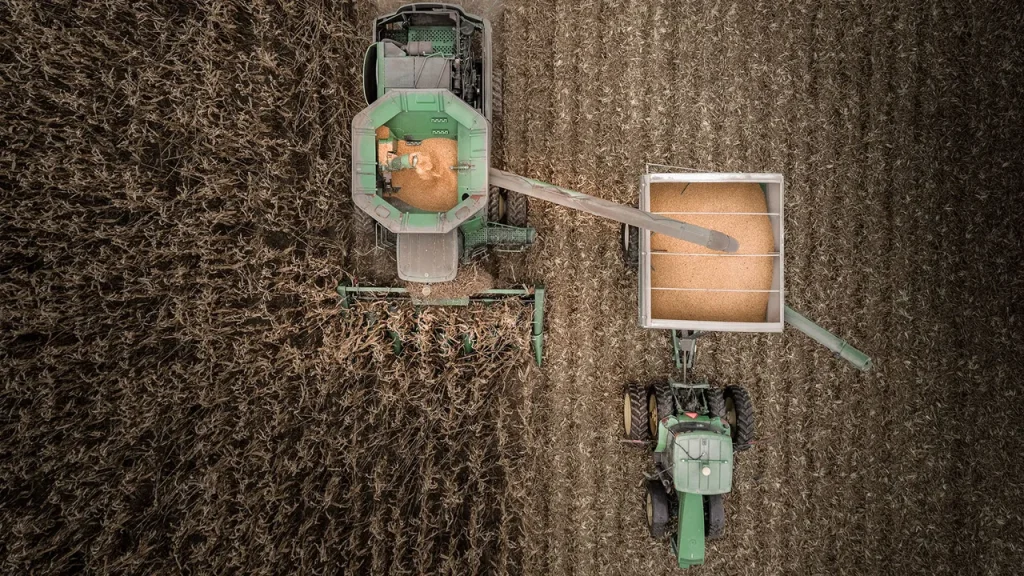
In July 2025, USDA held its corn yield forecast at a record 181.5 bushels per acre. However, total production was lowered by 45 million bushels—to 15.26 billion—due to a 400,000-acre reduction in planted area.
Why read this: Yield and supply forecasts shape market price expectations—key for deciding when and how to sell the crop.
Farmers Face Crucial Decision—W-2 Employee or 1099 Contractor
Farm owners must correctly classify workers as either W-2 employees or 1099 contractors based on how much control they have over the job and how independently the worker operates. W-2 status includes regular wages, tax withholdings, and contributions to Social Security and Medicare. 1099 contractors are paid per project, supply their own equipment, and receive no tax withholding.
Why read this: Getting this wrong can trigger IRS penalties, back taxes, and legal exposure—choosing the right status protects both the business and the budget.
USDA’s ‘Farm Security Is National Security’ Plan Sparks Strong Support
USDA has introduced a seven-point National Farm Security Action Plan that places agriculture at the center of U.S. national security policy. The plan includes protections for farmland, biosecurity, cybersecurity, and research infrastructure. It also proposes restrictions on foreign adversaries buying U.S. farmland.
Why read this: The policy could directly affect land deals, foreign partnerships, and how farmers access technology—especially near sensitive infrastructure.
Farm-State Senators See Opportunity in Brazil Tariffs
https://www.agri-pulse.com/articles/23188-farm-state-senators-see-opportunity-in-brazil-tariffs
Several U.S. senators from agricultural states believe that Trump’s proposed high tariffs on Brazilian imports could open new market opportunities for American producers. The tariff threat has prompted discussions around expanding U.S. ag exports and creating offset measures to strengthen domestic production and processing. Some lawmakers argue this could lead to increased investment in local ag infrastructure.
Why read this: This signals a possible shift in trade flows and future investment—key factors for farmers making long-term marketing and expansion decisions.
Trump’s Bold Tariff Strategy Has French Cheese and Wine Makers Trembling with Uncertainty
In July 2025, the Trump administration proposed a 30% tariff on EU imports, including French cheese and wine. France exports over €350 million worth of these goods to the U.S. annually—raising concerns that rising prices could wipe out competitiveness. French producers warn of a high risk of contract collapse due to tariff instability.
Why read this: Tariff hikes could shift consumer demand toward U.S.-made dairy and wine grapes—potentially boosting prices and revenue for domestic producers.
When will grain prices rally?
https://www.farmprogress.com/commentary/when-will-grain-prices-rally-
In a July interview, StoneX chief commodities economist Arlan Suderman explained that weather risks typically add a price premium to grain markets this time of year. However, Brazil’s large corn harvest and China’s weak demand for U.S. grain are holding prices down. Soybeans may offer better upside potential than corn in the near term.
Why read this: Understanding when prices might rise—or stay low—helps farmers time grain sales, manage storage, and plan marketing strategies more effectively.
Arsenic in Rice: What to Know About the Health Risks
https://www.nytimes.com/2025/07/01/well/eat/health-risks-arsenic-rice.html
In 2025, the FDA reported that over 50% of rice samples contained elevated levels of inorganic arsenic—a known carcinogen. Brown rice and baby rice products showed the highest concentrations. Experts advise reducing rice intake and rotating grain sources.
Why read this: New regulations and shifting consumer concerns could impact market demand, prices, and crop certification requirements.
USDA to host Great American Farmers Market this summer
https://www.agri-pulse.com/articles/23161-usda-to-host-great-american-farmers-market-this-summer
USDA will host the Great American Farmers Market on the National Mall in Washington, D.C., from August 3 to 8, 2025, during National Farmers Market Week. Registration is open to producers from all 50 states—including farmers, processors, and fishers. The event marks the nation’s 250th anniversary and aims to boost farmer-to-consumer connections.
Why read this: A unique chance to showcase products on a national stage, build direct sales channels, and elevate your farm brand.
Veteran Farmer Award of Excellence
https://www.fb.org/initiative/afbf-veteran-farmer-award-of-excellence
AFBF is accepting applications until September 5, 2025, for a $10,000 prize and up to $5,000 in travel reimbursement to attend the 2026 convention. The award honors current or former military members who demonstrate excellence in farming and community impact. Selection runs from June 17 to September 2, with the winner announced on Veterans Day, November 11.
Why read this: A meaningful opportunity for veteran farmers to gain recognition and financial support for their agricultural and community leadership.
Global Certification Opens Doors for U.S. Ag Professionals
The Global Academy of Finance and Management (GAFM), founded in 1996, partners with 1,000+ business schools across 150+ countries. It offers certifications in finance, economics, management, and ag-investment that are recognized globally. Credentials are valid for 2 years with an annual renewal option ($199 plus $29 fee).
Why read this: An international certification can enhance your credibility with partners, investors, and insurers—boosting your professional edge.
Thanks for reading! We’ll be back with more insights and updates in the next issue. Until then—stay sharp, stay ahead.