Production and sale of grain cleaning equipment worldwide
How Grain Cleaning Affects Farm Profitability
28 April 2025


Post-harvest grain cleaning has a direct impact on crop preservation—this is a fundamental axiom in agriculture. Modern grain sorting machines not only ensure proper storage but also contribute significantly to the profitability of the business.
First, processing with sixth-generation equipment alone offers considerable savings potential. Second, due to a number of technological solutions, the grain mass is processed with high precision. Need we say that top-grade grain commands 5–15% higher prices?

Cleaning, Calibrating, and Drying in a Single Pass
Freshly harvested grain is always contaminated—it contains inedible components such as sand, insects, rodent waste, weed leaves, and more. On top of that, it is always moist.
In hot weather, freshly harvested grain begins to self-heat within 10–12 hours, significantly lowering its quality. Even without extreme heat, hydrolysis—the breakdown of substances due to moisture—begins within 48 hours. Weeds and plant stems accelerate this process.
In short, the time window for comprehensive post-harvest treatment is limited. The task becomes even more complex when multiple crop types need to be processed simultaneously.
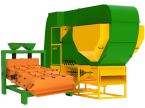
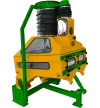
The technology developed by Metra Group is capable of cleaning and sorting grain of any size and contamination level. One single grain cleaner can replace multiple machines because, in a single pass, it:
- Removes all impurities and contaminants—Each machine is equipped with 68 injectors that instantly detect and eliminate all non-grain elements;
- Calibrates by fractions—Depending on the grain geometry and sorting requirements, it can divide grain into 3 to 5 fractions. It also supports color sorting;
- Reduces moisture—The mass loses up to 2% moisture content, which is often sufficient for storage.
Key Feature #1: Fungal Separation
The term “impurities” includes not only husks, weed seeds, and broken kernels—but also fungal contamination. A major advantage of Metra Group’s grain cleaners is their ability to detect and separate grains infected with mycotoxins.
Fusarium, smut, bruchus, vomitoxin, and other fungal diseases are deceptive—they can remain dormant for months. Just one infected kernel can spoil a significant portion of the harvest, rendering it unsuitable for consumption or future planting.
Key Feature #2: Gentle on Every Kernel
What is the best way to clean grain? The one that removes all impurities without damaging a single kernel.
Older-generation machines can’t guarantee this: on some farms, up to 8% of the harvest is damaged during post-harvest storage prep.
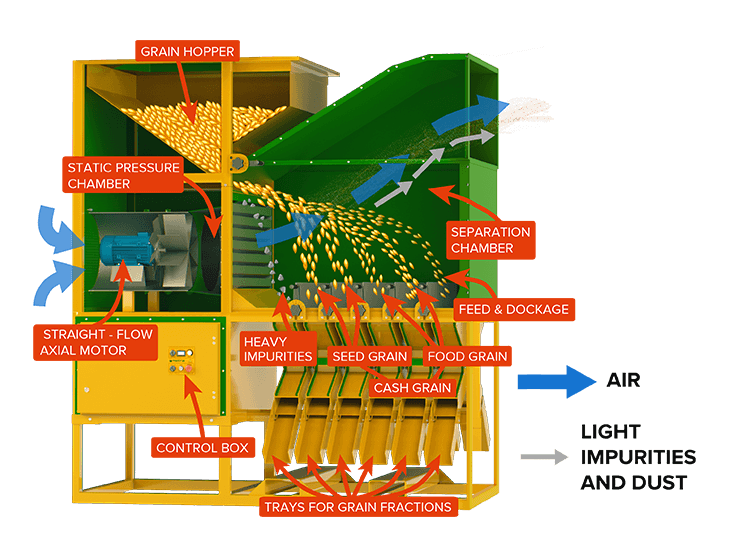
Metra Group addressed this issue at the design stage, knowing that most traditional air-screen cleaners damage grain. Thanks to aerodynamic technology, the grain has minimal physical contact with the machine’s components.
As a result, every processed batch becomes top-grade grain—improving market value and ensuring high-quality seed for the next planting season.
The Economics of a Clean Crop
Let’s imagine a farm harvesting 1,000 bushels of corn per season. Suppose the base export price for corn is $250 per bushel. If the grain contains just 4% impurities, it will not qualify as top-grade and may only fetch $240 per bushel.
That’s a loss of $10 per bushel, or $10,000 per shipment—losses that could easily be avoided.
Now consider the cost of cleaning and calibration. A rough market estimate: full cleaning (primary, secondary, and calibration) costs around $5 per ton.
This means the net profit for the farmer would be $5,000—a substantial gain.
However, these calculations don’t include several key advantages of Metra machines that further reduce operating costs:
- Low energy consumption—from 0.75 kWh to 22 kWh, depending on load;
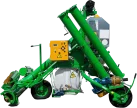
- Adaptability—Machines work efficiently both stationary and trailer-mounted, which is crucial for many farms;
- Ease of use—The machines handle mixed-size grain with no need to change or clean screens, lubricate parts, or reprogram the system. Switching between crop types takes under 10 minutes.
Upgrade your grain cleaning process with Metra’s aerodynamic technology today!
Contact us today for a personalized consultation and discover how our ADS and ADS-CDC grain cleaners can boost your farm’s productivity while reducing maintenance and energy costs
Conclusion
A modern grain cleaner is a strategic tool for managing farm profitability. It’s an investment that pays for itself in no more than two seasons, depending on your farm’s scale and needs.
Contact us, and we’ll help you choose a machine with the right capacity for your operation. Every model guarantees high-quality cleaning and better grain yield.
FAQ
How does post-harvest grain cleaning affect farm profitability?
Cleaning reduces losses, improves grain grade, and allows it to be sold at a higher price—5–15% more.
What are the benefits of “three-in-one” technology: cleaning, calibrating, and drying in a single pass?
It allows any type of grain to be processed, reduces moisture, and removes up to 100% of contaminants in one cycle without quality loss.
Why is it important to treat every grain gently during cleaning?
Mechanical damage lowers grain grade and reduces the germination rate of seed material. Aerodynamic cleaning minimizes contact with machine parts and preserves crop quality.