



Production and sale of grain cleaning equipment worldwide
Tell Soybean Staining From Seed Decay Before Calling the Buyer
17 November 2026
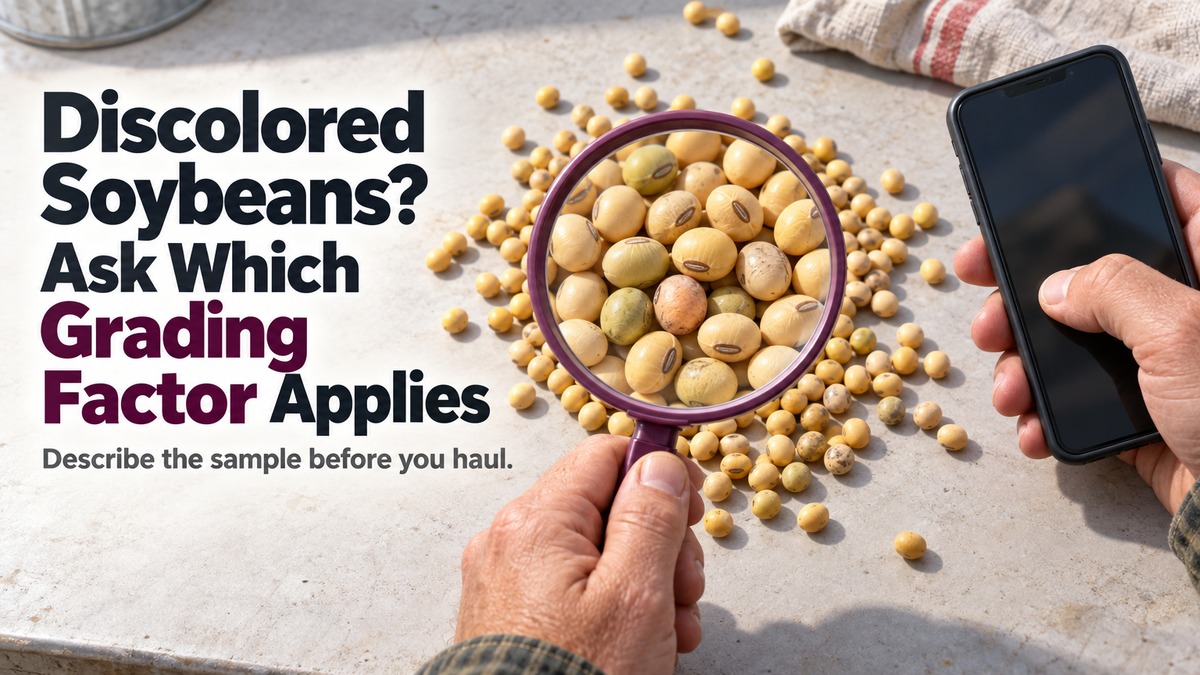
Start with the symptoms, then ask about the grade
Discolored soybeans do not all have the same problem. Purple staining points toward purple seed stain; cracked, shriveled, chalky beans point toward Diaporthe seed decay. Other discoloration may affect only the seed coat. Describe what you see, then ask the buyer which grading factor applies before hauling.
Three conditions worth separating
University of Minnesota Extension’s October 5, 2026 report described purple seed stain and Diaporthe seed decay in southern Minnesota, plus a separate seed-coat discoloration issue associated with some Enlist varieties. These symptoms are clues, not certain diagnoses.
Three Soybean Conditions Worth Separating
1. Purple Seed Stain
– What you see: Light-to-dark purple discoloration.
– What it may indicate: Purple seed stain, a fungal disease. Iowa State Extension described this color range in its September 29, 2026 report.
– What to ask the buyer: Is the buyer applying the Purple Mottled or Stained special grade?
2. Diaporthe Seed Decay
– What you see: Cracked, shriveled, wrinkled or chalky beans, sometimes with white or gray fungal growth.
– What it may indicate: Diaporthe seed decay. Look beyond color to the seed's physical condition.
– What to ask the buyer: Which beans are being counted as damaged kernels?
3. Seed-Coat Discoloration
– What you see: Seed-coat discoloration without affected internal tissues.
– What it may indicate: Minnesota Extension reported this separate condition in some Enlist varieties. Not every variety or environment showed it.
– What to ask the buyer: Is the concern Yellow versus Mixed class, or a separate contract requirement?
A lot can contain more than one condition. South Dakota State University Extension’s November 5, 2026 update included a central South Dakota soybean lot with both purple seed stain and Diaporthe seed decay.
Disease names and grading terms mean different things
USDA’s September 2023 soybean standards separate special grade, damaged kernels and soybean class. Ask which determination the buyer is making rather than accepting “off-color” as the full explanation.
Purple Mottled or Stained is not a disease diagnosis. Its definition includes discoloration from fungi, dirt and certain other nontoxic substances. The special-grade procedure evaluates pink or purple seed coats using an approximately 400-gram portion and an FGIS Interpretive Line Photograph—an official visual grading reference. Ask what sample findings support that designation.
Damaged kernels include diseased and mold-damaged soybeans and soybean pieces. That makes seed decay a damage question, not simply a color question. Ask for the damage percentage and which beans were counted.
Yellow versus Mixed is a class determination. Yellow soybeans may contain no more than 10.0 percent soybeans of other colors. That category includes black beans, bicolored beans as defined in the standard, and beans that are green both on the seed coat and in cross section. For bicolored beans, the standard specifies two seed-coat colors, with brown or black covering 50 percent of the coat; the hilum, or seed scar, is excluded. Soybeans that do not meet the Yellow class requirements are Mixed.
The 50 percent criterion concerns an individual bicolored bean. The 10.0 percent allowance concerns lot classification. Neither is a universal purple-stain rejection or discount threshold.
Get the buyer’s answer before hauling
Use the symptom comparison to make the conversation specific:
– “Are you evaluating this lot for Purple Mottled or Stained, damaged kernels, Yellow versus Mixed class, or a contract-specific requirement?”
– “Can you show me the sample findings and written rule behind that decision?”
– “What acceptance limits and discount schedule apply to my contract and delivery point?”
– “Can you review a sample before delivery, and what sample-review options are available if we disagree?”
For example, if the buyer calls purple-stained beans “Mixed,” ask which beans meet the standard’s soybeans-of-other-colors definition and what percentage they represent. Purple color alone does not explain that class decision. The useful answer is the named grading factor, the supporting sample findings and the terms that apply to your sale.
Discuss a grain sample test
If your soybeans contain discolored, shriveled or damaged kernels, cleaning and sorting may help separate unwanted material while retaining valuable beans. Metra 6AS optical color sorters can separate soybeans based on visible color differences, including purple-stained or otherwise discolored kernels. Metra ADS aerodynamic cleaners offer another approach when damaged or poorly filled beans respond differently to controlled airflow.
Not sure what cleaning can achieve with your soybeans?
Metra offers a free grain sample test. Send us a sample of your affected soybeans, and our team can demonstrate the separation, compare the original, cleaned and removed fractions, and help determine which cleaning technology best suits your material.
You can see how much useful grain is retained and evaluate whether sorting is worthwhile before investing in equipment.
Contact info@graincleaner.com to arrange your free sample test.