Production and sale of grain cleaning equipment worldwide
How Much Grain Cleaner Capacity Do You Actually Need?
5 August 2026



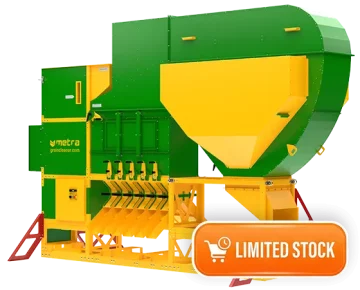


Choosing grain cleaning equipment based only on acreage or advertised maximum throughput can lead to an expensive mistake.
Two farms with similar acreage may need completely different grain cleaner capacities. One farm may clean wheat and barley gradually throughout the year. Another may need to process a large volume of corn and soybeans immediately after harvest. A seed producer handling oats, canola, sunflower, or peas may also need additional cleaning passes and more time for crop changeovers.
The right question is not simply:
How many bushels do you grow?
The more useful question is:
How many bushels must you clean, how many times must they pass through the machine, and how many productive operating hours do you actually have?
This guide explains how to calculate the grain cleaner capacity your farm needs in bushels per hour, or BPH, while accounting for crop volume, available time, multiple passes, downtime, and changes between crops.
What Does Grain Cleaner Capacity Mean?
Grain cleaner capacity is generally expressed in bushels per hour, commonly abbreviated as BPH, bu/h, or bu/hr.
For example, a grain cleaner rated at 800 bushels per hour can theoretically process 800 bushels during one hour of operation under suitable conditions.
However, rated capacity should not automatically be treated as the volume you will process during every hour of a normal working day.
Actual grain cleaning throughput may vary depending on:
- The crop being cleaned
- Grain moisture and condition
- Seed or kernel size and density
- The amount and type of foreign material
- The required level of cleaning
- The number of cleaning passes
- The consistency of the grain feed
- The settings used for each crop
- The capacity of augers and conveyors
- Time spent changing between crops
A wheat grain cleaner, corn cleaner, soybean cleaner, or seed cleaner may use the same basic equipment, but the operating settings and practical throughput can differ from one crop and cleaning objective to another.
That is why proper grain cleaner sizing should begin with your farm’s real operating schedule, crop mix, and cleaning requirements rather than the highest BPH number shown in a product description.
The Basic Grain Cleaner Capacity Formula
A practical starting formula is:
Required effective capacity = Total processing workload ÷ Available productive cleaning hours
Your total processing workload should include every pass through the machine:
Total processing workload = Bushels to be cleaned × Number of passes
After calculating the effective capacity, add a reserve for interruptions, adjustments, crop changes, and inconsistent grain flow.
A more complete formula is:
Recommended rated capacity = Required effective capacity ÷ Expected utilization rate
For planning purposes, a farm may use an estimated utilization rate of approximately 65% to 80%.
This does not necessarily mean that the grain cleaner itself is inefficient. It simply recognizes that an eight-hour workday rarely provides eight hours of continuous grain flow.
Time may be required to load grain, empty screenings, inspect the cleaned product, change settings, move equipment, and coordinate bins, trucks, augers, or conveyors.
Step 1: Calculate the Volume of Each Crop
Begin with the number of bushels you expect to clean during the season or year.
Do not automatically use your entire harvested volume. Some farms clean every bushel before storage, while others clean only selected grain lots.
You may need to clean grain that is:
- Going into long-term storage
- Intended for planting seed
- Being prepared for a specific buyer
- Containing excessive fines or foreign material
- Affected by light or poorly developed kernels
- Being separated into different quality fractions
- Intended for a specialty or higher-value market
If you grow multiple crops, calculate each crop separately.
For example:
- Wheat: 30,000 bushels
- Corn: 45,000 bushels
- Soybeans: 20,000 bushels
- Barley: 12,000 bushels
- Oats: 8,000 bushels
- Canola: 6,000 bushels
- Sunflower: 5,000 bushels
- Field peas: 4,000 bushels
Total potential annual volume: 130,000 bushels
However, total annual volume alone does not determine the required grain cleaner capacity.
A machine may be able to process 130,000 bushels over several months but still be too small if 40,000 bushels of wheat must be cleaned in one week or if corn must be processed immediately before storage.
Calculate both the annual volume and the largest volume that must be cleaned within a limited time window.
How Crop Type Affects Grain Cleaner Capacity
The same grain cleaner may be used for multiple commodities, but wheat, corn, soybeans, barley, oats, canola, sunflower, and peas should not automatically be treated as identical processing loads.
Crop type can affect grain flow, machine settings, the amount of foreign material, and the time required to reach the desired result.
Wheat Grain Cleaning
When sizing a wheat grain cleaner, consider whether the goal is basic pre-cleaning, preparation for storage, removal of light kernels, or more precise seed cleaning.
Wheat with a high level of chaff, dust, light kernels, or damaged material may require slower feeding or an additional pass compared with relatively clean grain.
If wheat represents a large portion of your harvest, calculate its required capacity separately instead of averaging it together with lower-volume crops.
Corn Cleaning
Corn is often handled in large seasonal volumes, which can make available time especially important.
A corn cleaner may need to process a substantial number of bushels between harvest, drying, storage, or delivery operations. Even when only one cleaning pass is planned, a short operating window can create a high BPH requirement.
The capacity of the receiving hopper, augers, conveyors, and discharge equipment is particularly important when planning a high-volume corn cleaning system.
Soybean Cleaning
Soybeans may be cleaned before storage, processing, sale, or use as planting seed.
When calculating soybean cleaner capacity, include any grain lots that may require more careful separation or an additional pass. Also allow time to remove remaining grain and adjust the cleaner before switching between soybeans and other crops.
Barley and Oat Cleaning
Barley and oats may contain light material, hulls, chaff, or underdeveloped grain that affects the cleaning process.
A barley cleaner or oat cleaner should be sized according to the actual incoming grain condition and the final result required. Seed preparation may require more cleaning time than basic removal of foreign material before storage.
If wheat, barley, and oats are harvested during overlapping periods, calculate whether the same grain cleaner can process all three crops within the available seasonal window.
Canola Cleaning
Canola seed differs considerably from larger crops such as corn, soybeans, or peas.
When planning canola cleaner capacity, do not assume that the BPH achieved with a larger grain will automatically apply under every canola cleaning condition. Feed consistency, machine settings, the amount of dockage, and the required separation result can all affect practical throughput.
Canola should therefore be included as a separate line in your capacity calculation.
Sunflower Seed Cleaning
Sunflower seed cleaning may involve removing light material, plant residue, poorly developed seeds, and other foreign material.
The required sunflower cleaner capacity depends not only on total bushels but also on the condition of the harvested material and whether the crop is being prepared for storage, processing, sale, or planting.
Allow enough time for machine adjustment and inspection of the cleaned fractions before operating continuously at the selected feed rate.
Pea Cleaning
Field peas are larger and flow differently than small grains or oilseeds.
A pea cleaner may be used to remove light material, broken or damaged peas, plant residue, and other impurities. When peas are intended for seed or a specialty market, the desired final quality may require a more precise setup or more than one pass.
Include peas separately when estimating both processing volume and crop changeover time.
Step 2: Determine Your Available Cleaning Window
Next, calculate how many days and hours you can realistically operate the grain cleaner.
Suppose you plan to clean grain for:
- 10 working days
- 8 scheduled hours per day
That gives you 80 scheduled hours.
However, you probably will not clean continuously for all 80 hours.
Time may be lost to:
- Loading and unloading
- Adjusting airflow or feed rate
- Inspecting cleaned grain
- Emptying screenings
- Moving equipment
- Switching between storage bins
- Waiting for trucks or conveyors
- Cleaning between crop varieties
- Changing from wheat to corn, soybeans, or another crop
If you expect approximately six productive cleaning hours during an eight-hour day, your real available cleaning time would be:
10 days × 6 productive hours = 60 productive hours
Using realistic productive hours gives you a much more reliable grain cleaner capacity estimate.
Step 3: Account for Multiple Cleaning Passes
Not every grain cleaning job requires the same number of passes.
A single pass may be sufficient when the objective is basic pre-cleaning, removal of light foreign material, or preparation for storage.
Additional passes may be required when:
- The incoming crop contains a high level of impurities
- Grain is being prepared for planting seed
- Several quality fractions are being separated
- A first pass is used for pre-cleaning
- A second pass is used for more precise separation
- The buyer requires a higher level of cleanliness
- The crop contains multiple types of unwanted material
Every additional pass increases the workload placed on the grain cleaner.
For example, cleaning 30,000 bushels of wheat once creates a workload of:
30,000 processed bushels
Cleaning the same wheat twice creates a workload of:
30,000 bushels × 2 passes = 60,000 processed bushels
For a mixed-crop farm, calculate the workload of each crop individually.
Example:
- 25,000 bushels of wheat cleaned once = 25,000
- 15,000 bushels of corn cleaned once = 15,000
- 10,000 bushels of soybeans cleaned once = 10,000
- 5,000 bushels of barley cleaned twice = 10,000
- 4,000 bushels of oats cleaned twice = 8,000
- 3,000 bushels of canola cleaned twice = 6,000
- 3,000 bushels of sunflower cleaned once = 3,000
- 2,000 bushels of peas cleaned twice = 4,000
Total physical crop volume:
67,000 bushels
Total grain cleaner workload:
81,000 processed bushels
Although the farm harvested 67,000 bushels, the machine must complete 81,000 bushels of processing because several crops require a second pass.
Step 4: Include Crop Changeover Time
A grain cleaner used for several crops will normally require operating adjustments when moving from one commodity to another.
Changing from wheat to barley may require less preparation than switching from corn to canola, but every operation is different.
Crop changeover time may include:
- Emptying the previous crop
- Removing remaining grain and screenings
- Cleaning areas where grain may accumulate
- Adjusting airflow
- Changing the feed rate
- Checking the separation result
- Preventing unwanted mixing between crops or varieties
One or two crop changes may have little effect on annual capacity. Frequent changes between small grain lots can significantly reduce productive operating hours.
A farm cleaning one large lot of corn and one large lot of soybeans has a different scheduling requirement from a seed operation that switches regularly between wheat, barley, oats, canola, sunflower, and peas.
Estimate the number of crop changes and subtract that time before calculating your required BPH.
Step 5: Add a Realistic Capacity Reserve
Avoid selecting a grain cleaner that must operate at 100% of its rated capacity during every available hour.
A machine that is just large enough on paper may become a bottleneck when:
- Harvest volume is higher than expected
- Grain contains more foreign material than usual
- Another cleaning pass becomes necessary
- The cleaning window becomes shorter
- A conveyor or auger causes an interruption
- Crop changeovers take longer than expected
- The farm adds acreage
- You begin cleaning grain for another farm
A practical method is to divide your required effective capacity by an expected utilization rate.
For example:
Required effective capacity: 600 BPH
Expected utilization rate: 75%
Recommended rated capacity:
600 ÷ 0.75 = 800 BPH
In this example, a grain cleaner rated around 800 BPH provides a more realistic capacity than a machine rated at exactly 600 BPH.
Complete Grain Cleaner Capacity Example
Consider a farm that needs to complete 72,000 bushels of total processing work.
The farm has:
- 12 available working days
- 8 scheduled hours per day
- Approximately 6 productive cleaning hours per day
- Several crop changes during the cleaning period
First, calculate available productive hours:
12 days × 6 productive hours = 72 hours
Next, divide the processing workload by the productive hours:
72,000 bushels ÷ 72 hours = 1,000 BPH
The farm therefore requires an effective cleaning rate of approximately 1,000 bushels per hour.
Now add a capacity reserve using a 75% utilization rate:
1,000 ÷ 0.75 = 1,333 BPH
A grain cleaner in approximately the 1,400 to 1,600 BPH capacity range may provide a more practical starting point than a machine rated at exactly 1,000 BPH.
The final selection should still be based on the crops being processed, the amount and type of impurities, the required result, and the capacity of the surrounding grain handling equipment.
Size the Entire Grain Handling System
Your grain cleaner cannot operate at its intended capacity if the surrounding equipment cannot keep up.
Before selecting a machine, compare its capacity with your:
- Receiving hopper
- Feed auger
- Bucket elevator
- Conveyor
- Clean grain discharge system
- Screenings discharge system
- Trucks and grain carts
- Storage bins
For example, installing a 2,000 BPH grain cleaner will not produce 2,000 BPH of finished grain if the feed auger can supply only 1,000 BPH.
This applies whether you are cleaning wheat, corn, soybeans, barley, oats, canola, sunflower, or peas.
The grain cleaner should be sized as part of the complete handling system. Feeding and discharge equipment must provide consistent flow without repeatedly stopping the cleaning process.
Should You Buy a Larger Grain Cleaner for Future Growth?
Purchasing slightly more grain cleaner capacity than you currently need may make sense when you expect:
- Additional acreage
- Higher yields
- More grain to be cleaned before storage
- Expansion into seed production
- Additional crops in your rotation
- Custom grain cleaning for neighboring farms
- A shorter seasonal cleaning window
- Entry into specialty or higher-value markets
However, the largest machine is not always the best choice.
An oversized grain cleaner may increase the purchase price without improving the overall operation. It may also require larger feeding equipment, additional storage coordination, or changes to the facility layout.
The goal is not to purchase the highest available BPH rating. The goal is to create a grain cleaning system that fits your crop volume, schedule, crop mix, handling equipment, and final quality requirements.
Questions to Answer Before Choosing a Grain Cleaner
Before requesting an equipment recommendation, prepare the following information:
- Which crops will you clean?
- How many bushels of each crop will you process?
- Will you clean wheat, corn, soybeans, barley, oats, canola, sunflower, peas, or other crops?
- How many passes will each crop require?
- How many days are available for cleaning?
- How many productive hours can the machine run each day?
- What impurities or damaged grain must be removed?
- Is the grain being cleaned for storage, sale, feed, processing, or seed?
- How frequently will you switch between crops?
- What is the capacity of your augers and conveyors?
- Do you expect your crop volume to increase?
These answers make it much easier to compare grain cleaner models and determine the bushels-per-hour capacity your operation actually needs.
Find the Right Grain Cleaner Capacity for Your Farm
Choosing the right farm grain cleaner is not about buying the smallest machine that can eventually process your crop.
It is about making sure your wheat, corn, soybeans, barley, oats, canola, sunflower, peas, and other crops can be cleaned within the time available without forcing the equipment to operate at maximum capacity every hour.
Metra supplies grain cleaning equipment for farms and agricultural operations with different crops, annual volumes, contamination problems, and throughput requirements.
When you contact Metra, tell our specialists:
- Which crops you grow
- How many bushels you need to clean
- How much time you have
- What impurities you need to remove
- Whether you expect one or multiple passes
- What grain handling equipment you already use
The Metra team will help you calculate the required grain cleaner capacity and identify an appropriate equipment configuration for your operation.
Call Metra or request a no-obligation consultation to find the right grain cleaner capacity for your farm.
Tel: +1 701 515 04-88
email: info@graincleaner.com