Production and sale of grain cleaning equipment worldwide
5 Hidden Costs of Outdated Grain Cleaning Equipment—and How to Stop the Bleeding
2 June 2025

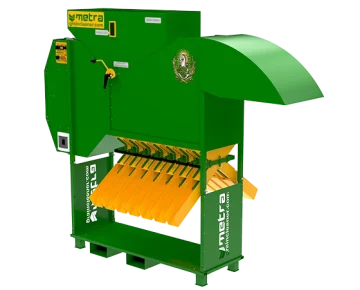

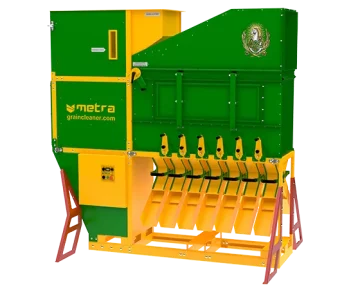


Even when an old grain cleaning line still “runs”, it silently determines the final margin of every bushel. If a 1980s machine develops microcracks or misalignments, the hidden cost of contamination and downtime will eat into your profits even before the first contract is signed. How can you avoid losses caused by outdated equipment? Why does modernization restore profit control and open access to new, higher-paying markets? This article has the answers.
Hidden Cost #1: Increased Operating Expenses
Worn bearings, unregulated rotors, and IE2–IE1 class motors increase energy consumption by 15–25%. For example, the aerodynamic ADS-400 consumes 1 HP per 400 bushels/hour, whereas an old drum “veteran” uses twice as much.
Most often, the costs come from the following issues with old machines:
- an unbalanced rotor causing vibration and energy loss;
- weekly lubrication and belt tightening;
- uneven startup without a frequency inverter, which spikes peak load.
Remember, the biggest hidden elevator payment is excess kilowatts, not bearing repairs.
Why does modernization help?
Aerodynamic grain cleaning equipment with a frequency drive and auto-balancing reduces OPEX by an average of 22% in the first year, which means you gain profit that your old equipment had been losing.
Hidden Cost #2: Yield Loss and Grain Grade Downgrade
Microcracks in the housing, “foggy” screens, and uneven airflow take away 0.5–1.2% of yield every season. A batch that could be sold as food grade ends up as feed.
Just consider the math: 0.8% loss on 500,000 bushels = minus $40,000 due to contamination alone.
How does it look in numbers?
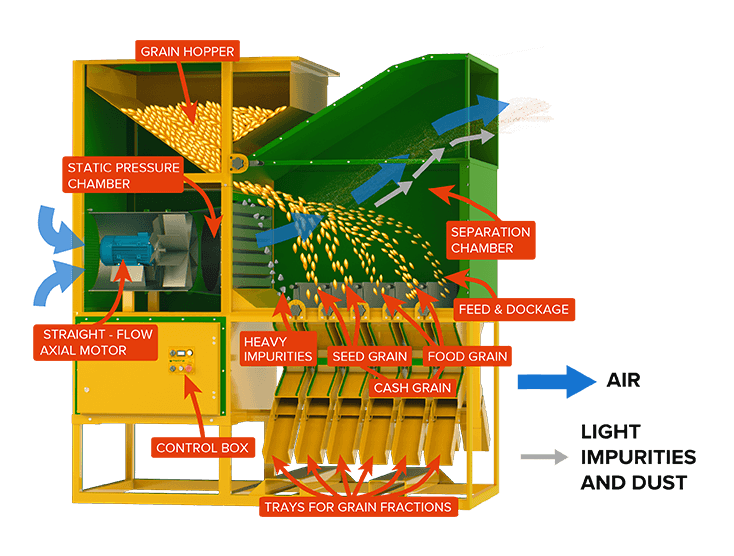
Compact grain cleaning equipment with photo sensors and dynamic flow control restore product grade and pay off in less than 12 months thanks to the price difference between feed and food-grade grain. This directly affects the profitability of every agricultural enterprise and therefore speaks in favor of purchasing modern equipment from Metra that meets all contemporary standards.
Hidden Cost #3: Decreased Productivity at Harvest Peak
A misaligned belt or a “stuck” drum halts the entire chain: the dryer shuts down and combines queue up at the elevator. Not exactly a picture of extra profit!
Typical downtime scenario:
- separator stops;
- combines line up;
- grain heats up in the bunker;
- diesel costs increase and spoilage risk rises.
As we can see, problems with outdated equipment can lead to unpredictable situations that create negative consequences throughout the entire production cycle. At the same time, the PLC controller and self-cleaning system of modern aerodynamic grain cleaners maintain a high processing rate—4,000 bushels per hour—without operator intervention, eliminating downtime and preventing grain overheating.
Hidden Cost #4: Increased Accident Risks
Old motors overheat easily, making it hard to speak of their safety. Even a single spark in grain dust may be enough to trigger immediate ignition. Moreover, you should be aware that most insurance companies today raise premiums if the production line lacks:
- LOTO locking system;
- belt break sensors;
- bearing thermal cameras;
- aerosol fire suppression.
New seed grain cleaning equipment eliminate this risk and restore insurance rates to base levels, keeping your company off the radar of insurers looking to raise premiums. The decision to purchase modern equipment makes it possible to reduce unplanned expenses—with insurance payments being a separate cost category.
Hidden Cost #5: Reputation Loss in Global Markets
Just one batch with 2% impurities, and traders flag the producer as “high risk”. Reputation is a trust deposit: lost in a day, restored over years. This can prevent your company from positioning itself as a premium-grade supplier even after fixing the issue.
Aerodynamic machines with cloud-based quality logging certify every bushel and automatically generate real-time purity certificates, ensuring stable contract fulfillment with no delays. Upgrading the equipment line can confidently be viewed as a capital investment in your reputation, enabling access to higher-value contracts and, as a result, growth in the enterprise’s profit-generating segments.
Why Should You Modernize Your Line as Soon as Possible?
Grain cleaning is where your margin is born. Modernization eliminates five hidden costs, minimizes risks, and ensures consistent quality.
We can create the following action plan to stop your company’s financial losses on time:
- conduct an audit (kWh, % rejects, cycle duration);
- choose a line from 200–8,000 bushels/hour with an IE4 motor and remote monitoring;
- calculate ROI and attract funding: leasing or grants covering up to 40% of CAPEX.
Order air grain cleaning equipment from Metra to avoid unnecessary losses and optimize your processes. Modern technology improves all operations, reduces energy costs, minimizes accident risks, and nearly eliminates human error. Your company can earn more—and we’ll show you how. Call us today and eliminate the losses you didn’t even know you had!
Frequently Asked Questions
Can I get away with “spot repairs” if the system still works?
Partial repairs don’t solve energy and safety issues. Full replacement is often cheaper within two seasons.
How much energy does an IE4 motor save compared to IE2?
About 0.15 kWh per bushel; a 4,000 bu/hour line saves up to 600 kWh per day.
What’s the minimum grain volume to justify the investment?
A farm cleaning 150,000 bushels per year breaks even in two seasons — and for larger volumes, even sooner.
Metra’s grain cleaning solutions are designed to tackle these common challenges, ensuring that small-scale farmers can maintain the highest standards of grain quality.
Contact us today to explore how our grain cleaning solutions can elevate your business