Production and sale of grain cleaning equipment worldwide
Cleaner Grain—Cleaner Planet: How Modern Grain Cleaners Help Cut Waste
2 June 2025


Selected seeds—both for sale and for the next sowing campaign. And also—significant savings of time and labor. These are the obvious advantages guaranteed to agribusinesses by sixth-generation grain cleaning machines from Metra. But there are also less obvious ones.
It’s about reducing the amount of harmful waste, and from there—extra benefits. First, material: in many countries, following environmental requirements directly affects business taxes. Second, reputational.
More on how grain cleaning systems are connected to protecting the environment—below.
First connection: preventing mycotoxin contamination
One of the most painful problems, well-known to farmers worldwide—fungal crop diseases. Fungi produce so-called “secondary metabolites”—mycotoxins. These are natural poisons that harm the health of humans and animals. According to alltech.com, over 95% of today’s crops are infected with at least one mycotoxin, usually two or more.
The main way to fight this problem is treating the fields with chemicals. But even timely and varied treatment doesn’t fully solve it: even one infected grain can spoil 5 to 50% of freshly harvested crops. All grain crops are at risk, but corn and wheat are the most susceptible to fungal diseases.
One of the design features of Metra machines is that they remove everything from the grain mass that is not healthy grain. “Everything” includes not only trash, weeds, insect remains, but also grains that have picked up mycotoxins—VOM, FUS, AFLATOXIN, and others. Older generation equipment is not able to detect them at all.
The technical solution that made a revolution
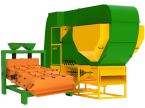
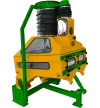
Metra grain cleaning devices clean grain using two air streams. In one technological pass, the grain is dried by up to 2% and at the same time separated into 3–5 fractions depending on geometry, size, or other set parameters—including color. At the same time:
- Large and small impurities are taken out through a special pipe to one compartment. Infected grains also go there—modern optics identify infected grains based on density and color.
- Light impurities—and mycotoxin dust belongs to them—are removed from the machine through a special dust collector. The machines have a dust disposal system that prevents re-contamination.
The Metra grain cleaner can choose the best seeds from the good ones—that’s its purpose. This also optimizes sprouting: crops ripen at the same time, and yield increases by up to 40%. Needless to say, seeds that have touched any mycotoxin simply do not reach the field.

Not sure which grain cleaner is right for you?
Contact us now for expert advice and find out how you can improve your grain quality and market value with Metra.
Second benefit: reducing energy use and CO₂ emissions
High electricity use is one of the causes of greenhouse gas emissions—the same ones that make the planet hotter and cause snow to fall in May. Many things affect this indicator, most of them part of everyday life. These include:
- using electric appliances at home,
- powering industrial equipment.
No one is asking you to give up air conditioners, printers, washing machines, or equipment—it’s just important to understand that if optimization is possible, it should be done.
Metra devices use 2.5 to 3 times less electricity than older-generation machines. This is the result of a completely new design, where the working wheel also acts as the power unit.
Small farms with low harvest volumes should look at small grain cleaning machines with power starting at 0.75 kWh—the same as a microwave or washing machine. Elevators will need a more powerful machine, with average energy consumption up to 22.0 kWh.
Each Metra is a multifunctional machine that replaces a production line of 2–3 regular grain cleaners. Thanks to this, energy costs go down by 18–22%. The farm pays less for electricity, and CO₂ emissions become at least a bit lower.
Instead of conclusions
That’s reason enough to start with yourself. And grain cleaning equipment is an investment that will pay off under any weather conditions. Taking care of the environment and what we leave on the planet after us—it’s not a trend, it’s a daily routine where nothing is too small.
Metra equipment uses not only sensitive optical and photodiode technologies but also artificial intelligence. Thanks to it, each grain cleaner keeps improving. And the smart system allows the manufacturer to connect to the machine at any time to set new parameters or perform a preseason check.
FAQ
How does grain cleaning help reduce the risk of mycotoxin contamination?
Modern grain sorting machines detect and remove grains affected by fungal diseases. They also clean the harvest from dust—this is where fungal spores are most often found. In addition, during sorting, the grain is dried by up to 2% in one pass. Together, these steps reduce the risk of post-harvest contamination by mycotoxins.
Is it true that dust and impurities don’t get back into the air or onto the field? How does that work?
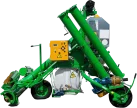
Dust and light impurities are separated and removed through a dust collector and screw conveyor. In other words, the sucked-up dust does not return into the air or soil but goes into a special compartment. This solution is important for farms that clean the harvest right in the field with mobile units and for elevators that have dedicated cleaning areas.
Can one Metra machine fully replace several other cleaners on a farm or elevator?
A Metra machine replaces several devices in one production line—a rough separator, aspirator, calibrator, and pneumo-separator. One Metra, in one pass, removes all trash and impurities from grain without damaging the seeds. It also calibrates the grain by set parameters and divides it into fractions.